



A changed stair landing calls for a post and footing investigation, not just a floor patch.
If a Reading basement stair landing has changed level beside a support post, a crack in the surrounding floor may be a symptom rather than the repair target. The post could bear on a separate footing below a nonbearing walking slab. It could also have been modified during a renovation. 603 Basement Solutions traces the stair and beam loads, measures the post and landing, and checks records before recommending concrete or structural work. Lifting or patching the visible floor without identifying what carries the landing can leave the important problem untouched.
We start with the stair. Has a riser changed, a stringer pulled from a connection, or a landing shifted relative to the basement wall? We inspect the framing that transfers load to the post or wall, not just the floor beneath it. A loose connection can produce a change that looks like settlement from below. Conversely, a post that has lost bearing may show a gap at its cap even if the floor crack is small. We note alignment, gaps, bearing contact and visible alterations, then compare those observations with floor elevations.
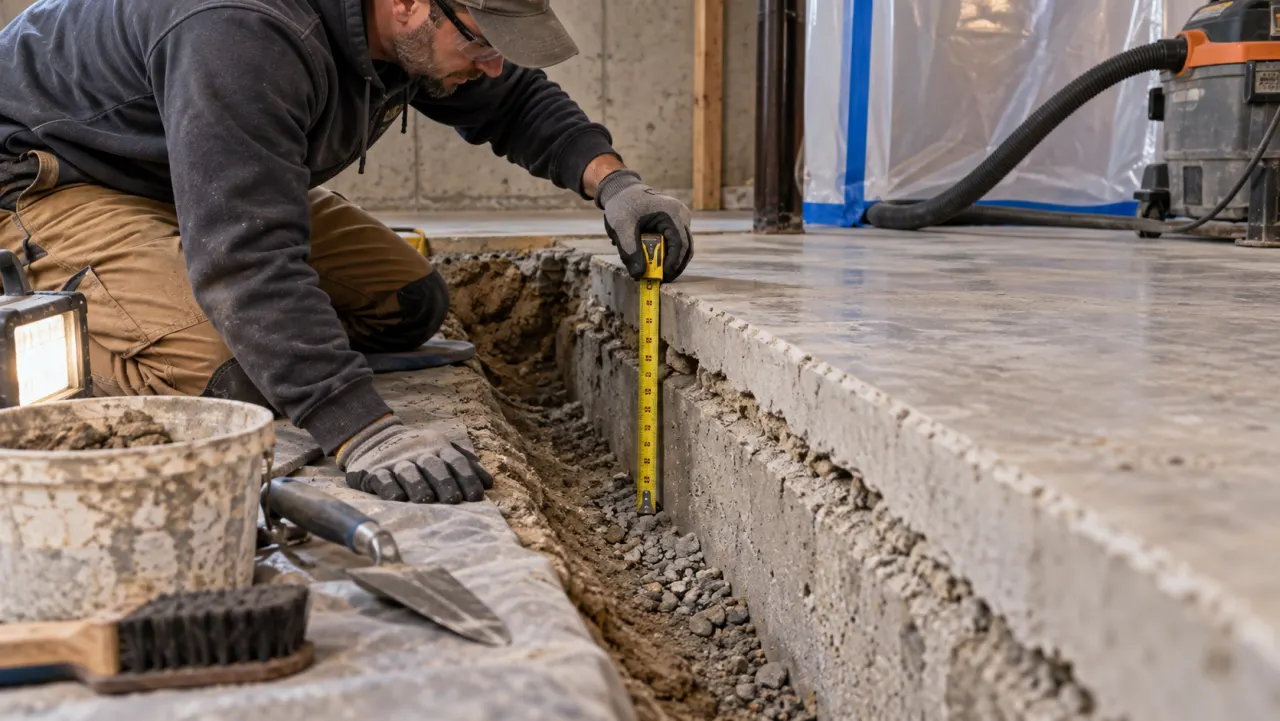
At the base, we distinguish the post plate, surrounding floor and any accessible footing edge. Plans or previous work records may reveal whether the post has an isolated footing, a thickened slab region or another support. If those sources are absent, the as-built detail remains unknown until a purposeful investigation. We do not tell a crew to cut a circle around a loaded post because a crack looks suspicious. The opening, temporary support and inspection sequence need a defined plan.
We record crack width, vertical offset, post plumb, landing elevation and repeatable photographs. The homeowner may have dated photos from a renovation or know when a door began rubbing. Those observations can help show progression, but they are not engineering measurements on their own. If framing and post contact are stable, a limited floor treatment or monitoring may be enough. If a beam gap or moving landing is present, a qualified structural professional may need to define the load-bearing repair.
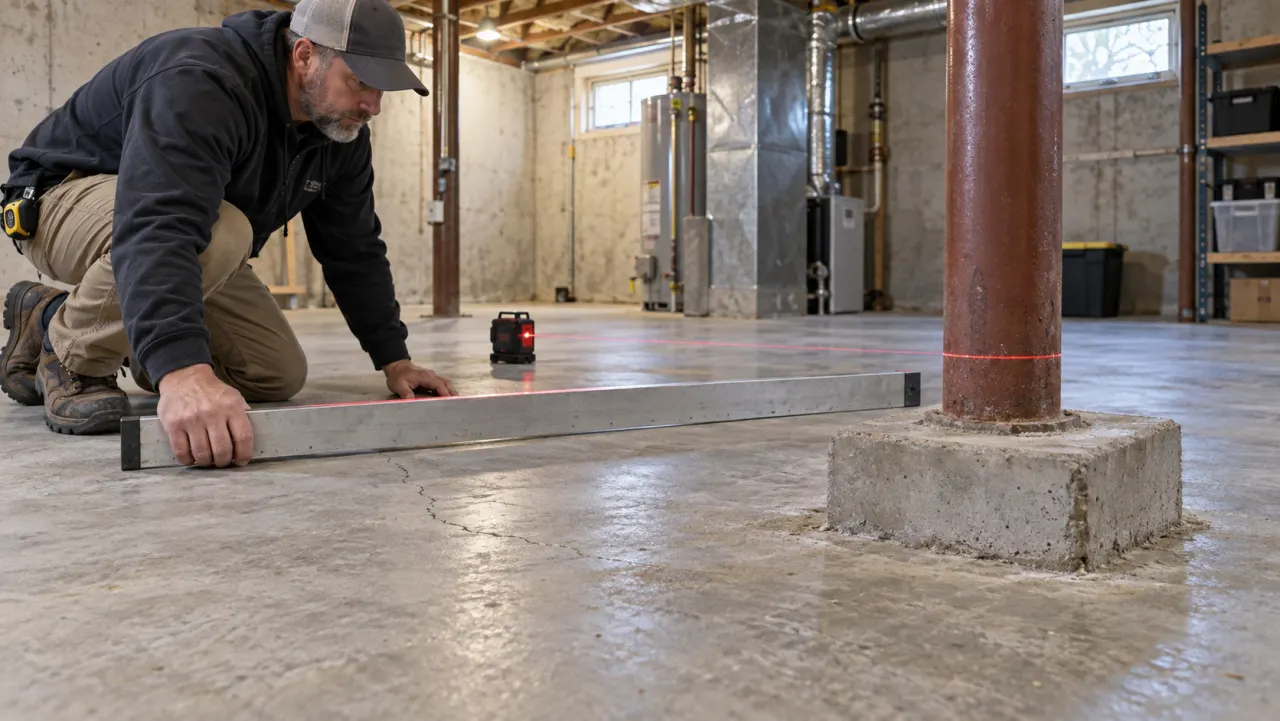
ACI’s slab-on-ground FAQ distinguishes soil-supported floor slabs from slabs that carry structural loads. ACI 332.1-18 addresses residential slabs and footings generally. Neither can identify the concealed support below this Reading landing. A basement floor can crack while a separate post footing remains sound. A post footing can move while the surrounding floor appears nearly intact. We name the affected element only after tracing the load path.
If the support remains sound, a bounded chip or stable crack may be concrete repair work. An intact low panel can be evaluated for concrete leveling only after the post and stair geometry are protected; raising floor alone could create a new trip step or force the post. A badly failed floor may justify concrete slab pouring with a base and moisture plan. Those are floor decisions. They cannot substitute for a defective footing or stair connection.
Where the bearing element is at risk, structural and foundation repair needs a scoped design and safe work sequence. A city article cannot prescribe a pier count, bracket, concrete thickness or jacking amount. The proposal should say what carries the load today, how the stair will remain usable or isolated during the work, and how the repair will be verified afterward. A bid that merely says “fill crack and level stair” leaves the core question unanswered.

Water near the stair could follow a floor crack, wall seam or plumbing route. We ask when it appears and keep a separate moisture record. Basement waterproofing may be appropriate for a verified water path, but it does not stabilize a post. Dry concrete does not prove the landing is safe either. An old basement finish or past stair relocation may conceal original footings or create a patch line that is unrelated to current movement.
The access plan matters in a finished basement. Exploratory work should answer a specific support question, with utilities located and the temporary bearing plan understood. If the floor and support both need work, the load should be secured before surrounding concrete is removed. We explain these dependencies to the owner so restoration and any specialist work are not surprises after the room is opened.

Google review · Customer experience
Natalie Leveille ★★★★★
“My experience with 603 Basements was exceptional! The process was easy, the workers were great, professional and experienced. They knew what they were doing and fixed everything! They came to the rescue when I could not find any help in NH! They took a wet, soppy, smelly, basement and turned it into an area with potential to be more than just a basement. Now I need them to come back to do the renovations to make it more! It was a delightful experience and I personally recommend them if you are having any basement issues”
The Reading Building Division is the local building-scope contact. Once we identify whether the work concerns a nonbearing floor, stair framing, post or footing, we confirm the applicable town process. We do not assert that every stair-adjacent floor crack needs a permit, and the town page does not reveal a particular home’s footing or soil conditions. The local fact is the review route, not a shortcut to a structural diagnosis.
Request a written scope that separates observation, targeted opening, temporary support, permanent remedy and floor restoration. Ask what measurement would show the proposed work succeeded and what discovery would change the plan. A homeowner should be able to compare a limited floor repair against structural intervention without pretending they solve the same problem.
Do not buy piers because a floor line points toward a stair post when the post, landing and beam are stable. Do not cover a changing gap or loose stair connection with a floor patch. A conservative monitor-and-repair decision may be right for a stable surface defect; a moving bearing point needs a different evaluation. Send 603 wide photos of the full stair, landing, framing, post top and base, plus any earlier photos. We will identify what is supported, what is merely nearby and what remains unknown.
Show us the affected concrete. We will explain what we measured, what can stay, and which scope fits the house.

