
Real 603 crawl space encapsulation
Damp crawl space in Hudson? It is usually the ground around your home, not a one-off leak. Much of Hudson’s higher ground, toward Hudson Center and the Litchfield line, sits on dense glacial till. That is an unsorted glacial soil that sheds water slowly and holds it against the foundation (NRCS New Hampshire Soils). Add humid summers, wet shoulder seasons, and about 53 inches of snow a year that melts off in spring (NOAA NCEI 1991-2020 Climate Normals, Nashua station), and a vented crawl space stays damp enough to grow mold and rot the wood above it. The fix is encapsulation. We seal the space with a heavy vapor barrier, then dry the air with a sump pump and a dehumidifier.
In Hudson, crawl space encapsulation usually runs $3,000 to $25,000. It depends on the size of the space, the shape the wood is in, and whether you need drainage underneath. Free inspection, free estimate, and a quote within 24 hours.
What crawl space encapsulation is
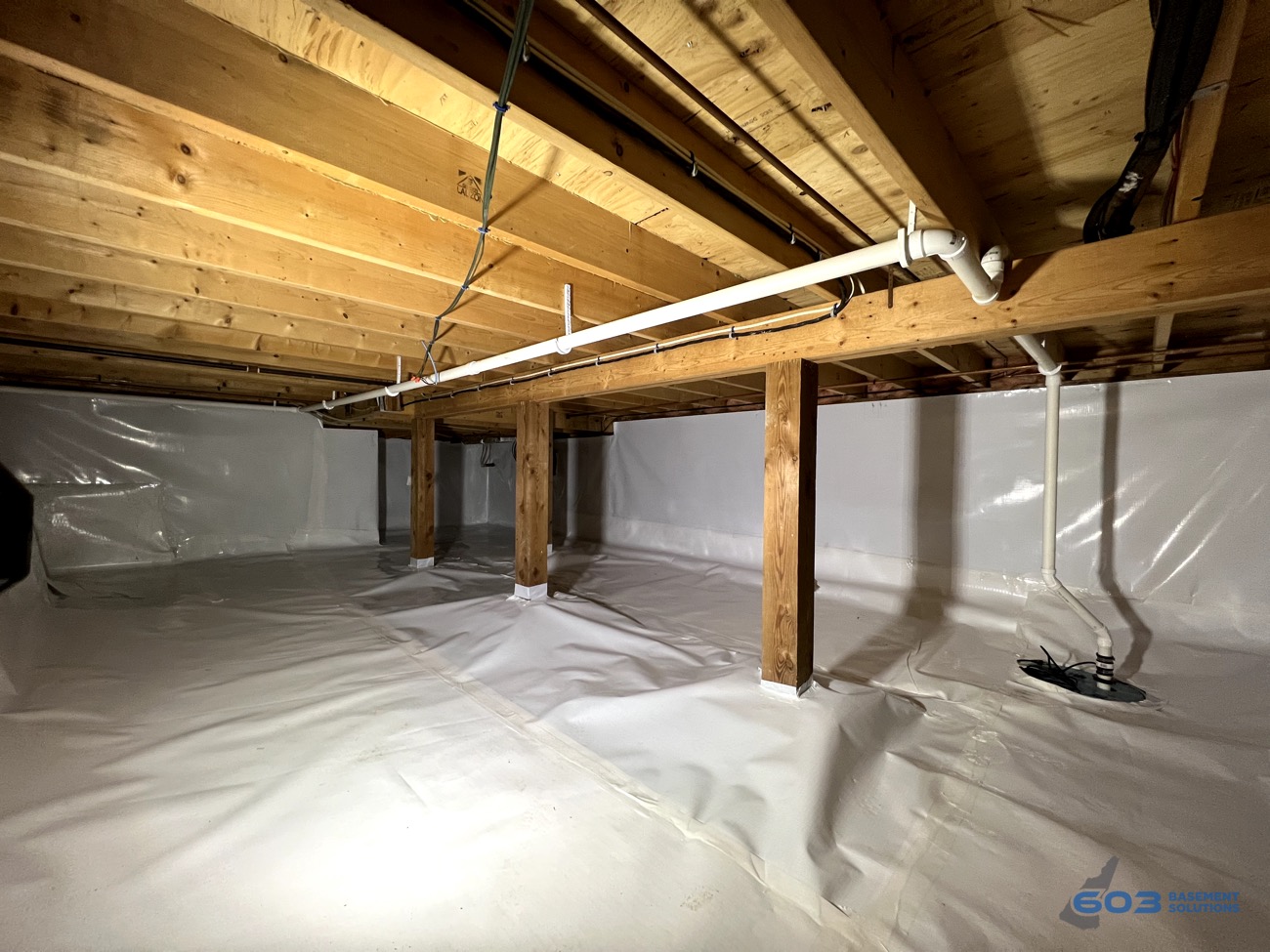
Encapsulation seals your crawl space off from the wet ground and the humid outside air, then keeps the sealed space dry. Here is the exact build we put in:
- A 12-mil vapor barrier on the walls.
- A 20-mil vapor barrier on the floor.
- Dimpled drainage matting under the floor barrier, so any water that gets in drains through to the sump instead of pooling.
- Every seam sealed with spray-foam insulation.
- A dehumidifier and a sump pump to pull the moisture out and keep it out.
Most folks notice the musty smell first. That smell is moisture trapped in the insulation and the wood. Mold is what grows in that moisture. Seal the ground, dry the air, and the smell goes with it.
We call this crawl space encapsulation. It is not the Forever Dry System. That is our basement waterproofing setup. We match the fix to the space.
Why Hudson crawl spaces stay wet
Three things drive it, and they are all local.
The soil holds water against the house. Much of Hudson’s higher ground, toward Hudson Center and the Litchfield line, is dense glacial till. Till is an unsorted mix the glaciers dropped, and it drains slow, so runoff sits and pushes toward your foundation (NRCS New Hampshire Soils). Closer to the river it flips. The Merrimack runs Hudson’s whole western boundary, and the lower parcels near it have sandy soils with a high seasonal water table (Wikipedia, Hudson, NH). Either way, the ground under your crawl space is wet for most of the year.
Then there is the wet ground inside town. The Musquash Conservation Area is 416 acres of swamp, upland forest, and wetland (Town of Hudson, Musquash), and Hudson also has Robinson Pond and Otternic Pond. Build near that, and your crawl space sits on or near saturated soil. The moisture rises right up into a vented space.
The weather finishes it off. Hudson summers are warm and humid, and the area gets about 53 inches of snow a year that has to melt off in spring (NOAA NCEI 1991-2020 Climate Normals, Nashua station). Warm, damp outside air vents straight into the crawl space, hits the cooler ground, and condenses. The shoulder seasons and the snowmelt keep the ground saturated underneath. A vent does not dry a crawl space here. It feeds it.
What Hudson’s homes are built like
Hudson grew up fast in the suburban boom, with the population jumping 81 percent in a single decade from 1960 to 1970 (Wikipedia, Hudson, NH). The median Hudson home went up in 1983 (Census Reporter, ACS 2024 5-year, table B25035), so most of what we work on is 1960s-to-1990s ranches and colonials. Homes from that era often sit over a vented crawl space, or a mix of crawl space and slab. That is exactly the build encapsulation is made for.
A smaller share of town is older. About 4.8 percent of Hudson homes predate 1940 (Census Reporter, ACS 2024 5-year, table B25034), mostly around historic Hudson Village and Hudson Center. Those tend to have fieldstone or dirt crawl spaces. There we install a sub-membrane system that handles the moisture and, when you need it, ties into radon control.
Hudson: local context
- Town: Hudson, Hillsborough County, NH (ZIP 03051), on the east bank of the Merrimack River across from Nashua (Wikipedia, Hudson, NH).
- Soil: Dense glacial till on the higher ground that drains slowly; sandy, high-water-table soils on the lower parcels near the Merrimack (NRCS New Hampshire Soils; Wikipedia, Hudson, NH).
- Wetlands: Musquash Conservation Area (416 acres of swamp and wetland), Robinson Pond, Otternic Pond (Town of Hudson, Musquash).
- Climate: Warm, humid summers, cold winters, and about 53 inches of snow a year that melts off in spring (NOAA NCEI 1991-2020 Climate Normals, Nashua station).
- Housing: Median build year 1983; about 4.8 percent of homes predate 1940. Owner-occupied rate about 82.6 percent; median home value about $438,900 (Census Reporter, ACS 2024 5-year).
- Radon: Tested homes in Hillsborough County average about 5.3 pCi/L, above the EPA action level of 4.0, across 5,528 pre-mitigation tests, the most of any NH county (American Lung Association, NH Radon Testing Disparity Report). EPA says test every home. If yours has a dirt or fieldstone crawl space, we can run a sub-membrane radon system under the same barrier.
Seal your crawl space and keep it dry
Damp crawl space in Hudson? It is usually the ground, not a leak. 603 seals it with a 12/20-mil vapor barrier, a sump, and a dehumidifier.
What it costs in Hudson
Crawl space encapsulation in Hudson runs $3,000 to $25,000. Where you land depends on the square footage, how wet the space is, the shape the wood and insulation are in, and whether you need drainage matting and a sump under the floor barrier.
| Service | 603 range (NH) |
|---|---|
| Crawl space encapsulation | $3,000 to $25,000 |
| Radon mitigation (if added) | $900 to $6,000, most homes around $1,950 to $2,250 |
| Radon test | $50 (credited toward the job if you proceed) |
We come out, get into the actual space, and give you a real number. No guessing from a brochure. Free inspection, free estimate, quote within 24 hours.
Why homeowners pick 603
We are a local, owner-run crew, not a national franchise. Chris is the Captain of the ship, and he is on every job. Nik is the Wizard behind the curtain, running operations. We are BBB A+ accredited (2022), rated 4.9 stars across 250 Google reviews, state-certified for radon mitigation, and licensed and insured. We have taken care of 5,000-plus homeowners across New England. You are not just another number to us.
Crawl space encapsulation carries a 25-year warranty on the liner, the wall barriers, and the workmanship. Sell the house, and that warranty goes to the next owner, as long as nobody else has touched the work.
What a recent customer said
Gerald and his crew did an excellent job, first cleaning out all the debris and the dislodged insulation in the crawlspace. they were very communicative and understood my concerns and handled them professionally. When they were finished laying the sublayment and the top vinyl covering, carefully taping all the seams they put insulating foam around the perimeter, sealing the top of the vinyl. Gerald communicated two issues that were not part of the contract that I will subsequently take care of myself. Great job, very satisfied.
Alex C Arcisz, ★★★★★ Google review
Frequently asked questions
Is crawl space encapsulation worth it in Hudson?
For most Hudson homes, yes. Much of the town sits on dense glacial till that drains slow, plus wetlands like the 416-acre Musquash Conservation Area and a high water table near the Merrimack. So vented crawl spaces stay damp and grow mold and rot. Encapsulation seals the space with a 12-mil wall barrier and a 20-mil floor barrier, then dries the air with a dehumidifier and a sump pump. In Hudson it usually runs $3,000 to $25,000.
Does a 1980s Hudson ranch need crawl space encapsulation?
Often, yes. The median Hudson home went up in 1983, so most of the stock is 1960s-to-1990s ranches and colonials, and homes from that era usually sit over a vented crawl space that pulls in moisture from the till and the humid summers. We get into the space first and tell you straight whether you need a full encapsulation or just some targeted moisture control. If it is the smaller job, that is what we will tell you.
Should I add radon mitigation when I encapsulate my Hudson crawl space?
Worth testing. Tested homes in Hillsborough County average about 5.3 pCi/L, above the EPA action level of 4.0, and EPA says test every home. If you have a dirt or fieldstone crawl space, we can run a sub-membrane radon system under the same vapor barrier. A radon test is $50, credited toward the work if you go ahead.
Ready to get started?
Free inspection, free estimate, and a written quote in your hands within 24 hours.
Common questions about crawl spaces
- Can ‘dormant’ mold spores appear and affect a crawl space?
- Can I use plastic sheeting as a vapor barrier?
- Crawl space is infested with mold, how do we go about properly fixing it?
- Does crawl space encapsulation increase home value?
- Does encapsulating a crawl space really work and is it worth the money?
- How does a vapor barrier function?
- How imperative is it that a house is anchored to a crawl space?
- How much does it cost to encapsulate the crawl space for a 3,000 sq ft house? Is it worth it?
- How much wood moisture in your crawl space can you tolerate
- How to get rid of moisture in a crawl space
- I had my crawl space encapsulated and outside vents sealed. Why have my radon levels gone up?
- I was told of an add-on for my crawl space encapsulation: insulation under the 20 mil white casing. Is that preferred?