
House smells musty and the basement is dry? Go look at what the back of the house is sitting on. It’s usually a crawl with a dirt floor.
Call 603-610-1770Get a free inspection
The crawl breathes into the rest of your house
Air in a house moves up. Warm air escapes out the top, and something has to take its place, so the house pulls air in low. When part of your house sits on a crawl, low is the crawl.
That’s how the smell gets to the kitchen. What you’re smelling is moisture sitting in the insulation and the wood down there, then whatever starts growing in it. The fiberglass stapled up between the crawl and your floor works like a sponge. It holds it.
It costs you money too. The Department of Energy puts as much as a third of a home’s heat loss through an uninsulated foundation. In a Manchester February you feel that through your socks.
One cold room and everything else fine. Go look at what’s underneath the cold room.
Those vents made sense to somebody once
Older crawls have vents cut into the foundation wall. The thinking was that a crawl needs to breathe.
Around here it does the opposite. On a humid August afternoon the outside air is warm and full of water. It comes through those vents, hits the cool dirt and the cool ductwork, and it condenses. That’s water you paid to let in.
Winter runs the same trick backwards. Plow banks and roof drip sit and melt at grade, and grade is where the vents are.
A sealed crawl is the approach we build, and we confirm what your town will pass before we start. We check what the code wants for your house before we close anything. And closing the vents only works if the rest of the job goes in with it.
Drainage first. Then the liner.
If there’s standing water in your crawl, a liner is the wrong thing to buy first.
Seal a wet dirt floor under nice thick plastic and the water is still there in April. Now you can’t see it, and it’s still feeding the wood. That’s the second step paid for before the first one.
Some crawls need drainage under the liner: a perimeter drain in the crawl, a pit, a pump, and then the barrier goes over the top of all of it. Do it in the other order and you pay for the liner twice.
We’ll tell you which one you’ve got once we’re under there. If it’s dry and it just needs sealing, that’s a smaller job and a smaller number, and we’ll say so out loud.
What actually goes in
A sheet of plastic laid loose on the dirt keeps your knees clean when you crawl in to change a furnace filter. That’s about all it does. Rodents walk it out of place, it rides up off the walls, and every seam is open.
Here’s the real spec:
- 12 mil vapor barrier up the walls
- 20 mil on the floor, since the floor takes the knees, the boots and anything you drag across it
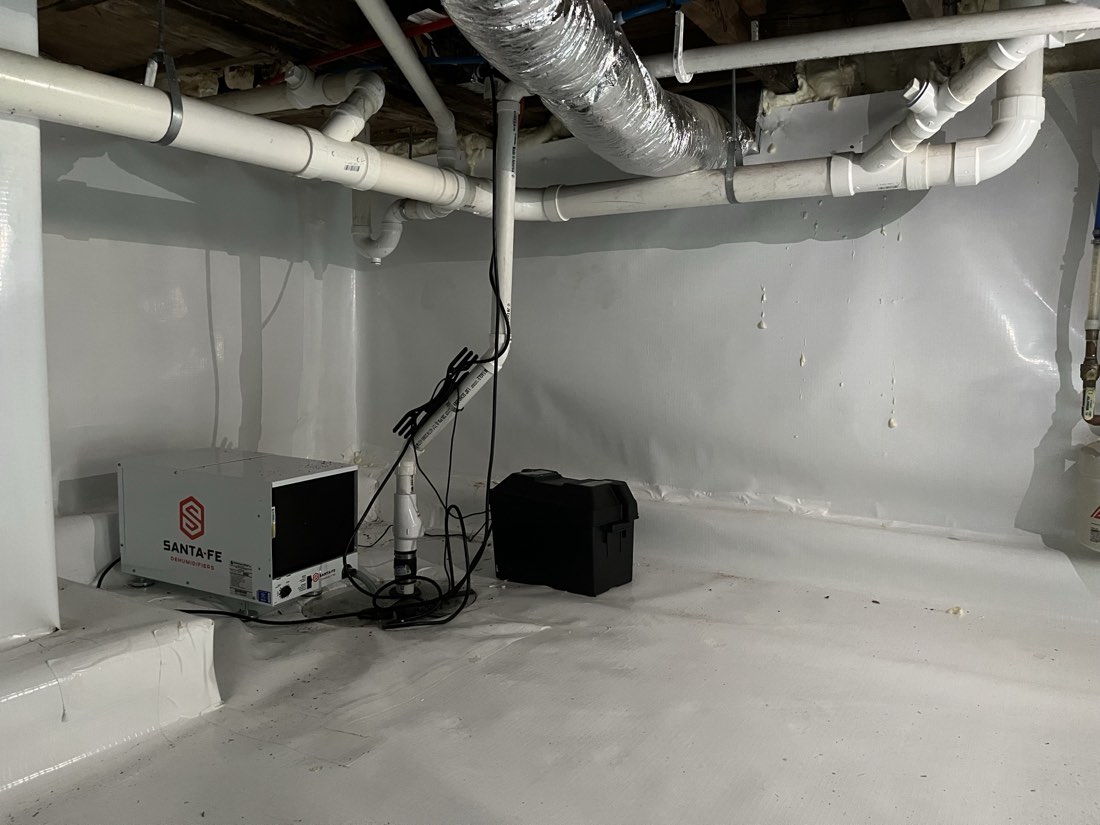
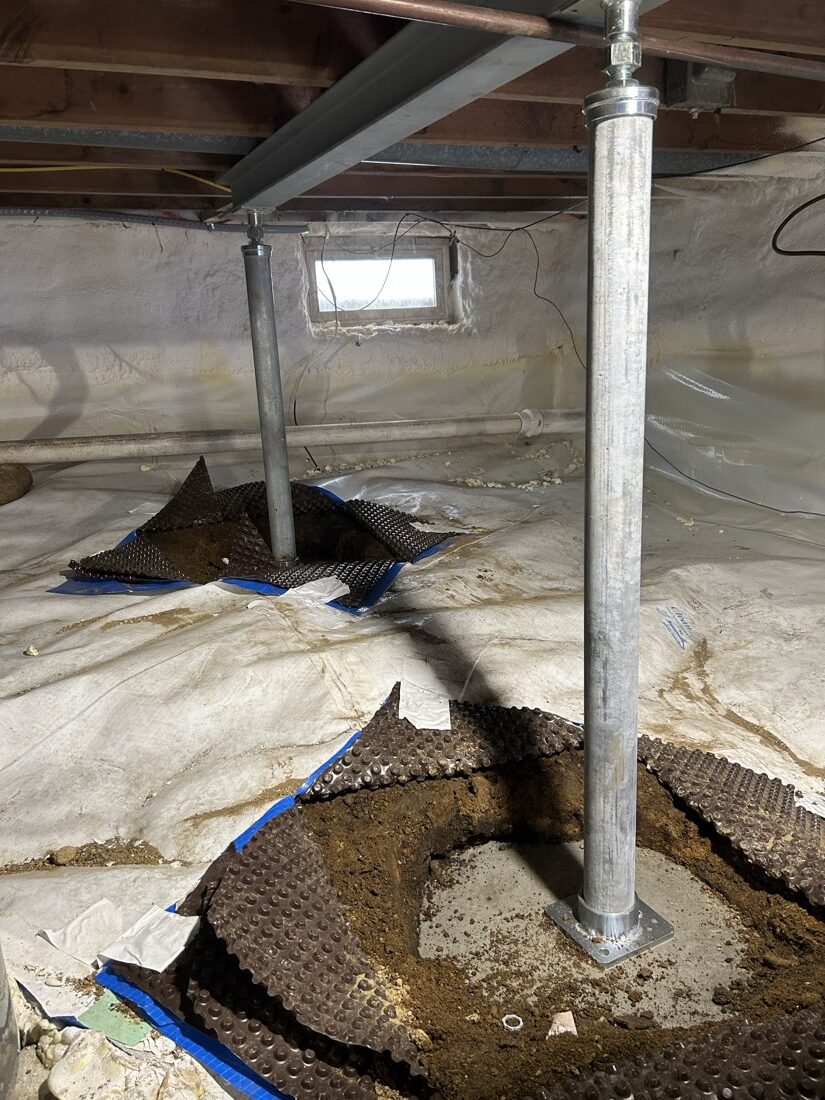
- dimpled drainage matting underneath that floor barrier, so water has somewhere to go and gets to the sump
- every seam sealed with spray foam, and that includes around the piers, the pipes and the duct boots
- the vents closed and sealed for good, along with the other outside air leaks up at the sill
- a dehumidifier, to keep the air in the sealed space dry
That’s the whole system. Leave a piece of it out and the space stays damp.
The encapsulation carries a 25 year warranty on the liner, the wall barriers and the workmanship. The sump system carries 3 years, batteries excluded. The dehumidifier carries 5 years on the manufacturer’s terms.
Radon comes up through a dirt floor
Worth knowing before you seal anything. Soil gas moves up through bare dirt. A liner slows that down. Venting it takes a separate system.
For a crawl we install a sub membrane system, which puts the suction point under the liner and sends the soil gas outside instead of into the house. Separate job, separate price. Radon mitigation runs $900 to $6,000 and most homes land between $1,950 and $2,250. A test is $50, and we credit it back if you go ahead.
Plenty of people don’t need one. Test first, then decide.
What crawl space encapsulation costs in Manchester
$3,000 to $25,000.
Access moves that number more than square footage does. A crawl you reach through a hatch in a closet floor, with barely any headroom and ductwork in the way, is slow work next to one you walk into from the bulkhead. After that it’s whether you need the drainage layer and the pump, and what shape the old insulation and the framing are in before we start.
Free inspection, free estimate, written quote in your hands inside 24 hours. Hearth handles financing if you want it, subject to approval, and 603 makes nothing on it.
We took 159 calls out of Manchester in the last twelve months.
If the main part of the house is wet too, that’s basement waterproofing in Manchester. We also do radon mitigation, foundation crack repair and basement finishing here. Soft floors over a crawl are a support problem, and we price that out in our guides to lally columns and sill beam replacement. There’s a full cost breakdown on what a professional grade encapsulation costs.
Work we have done nearby
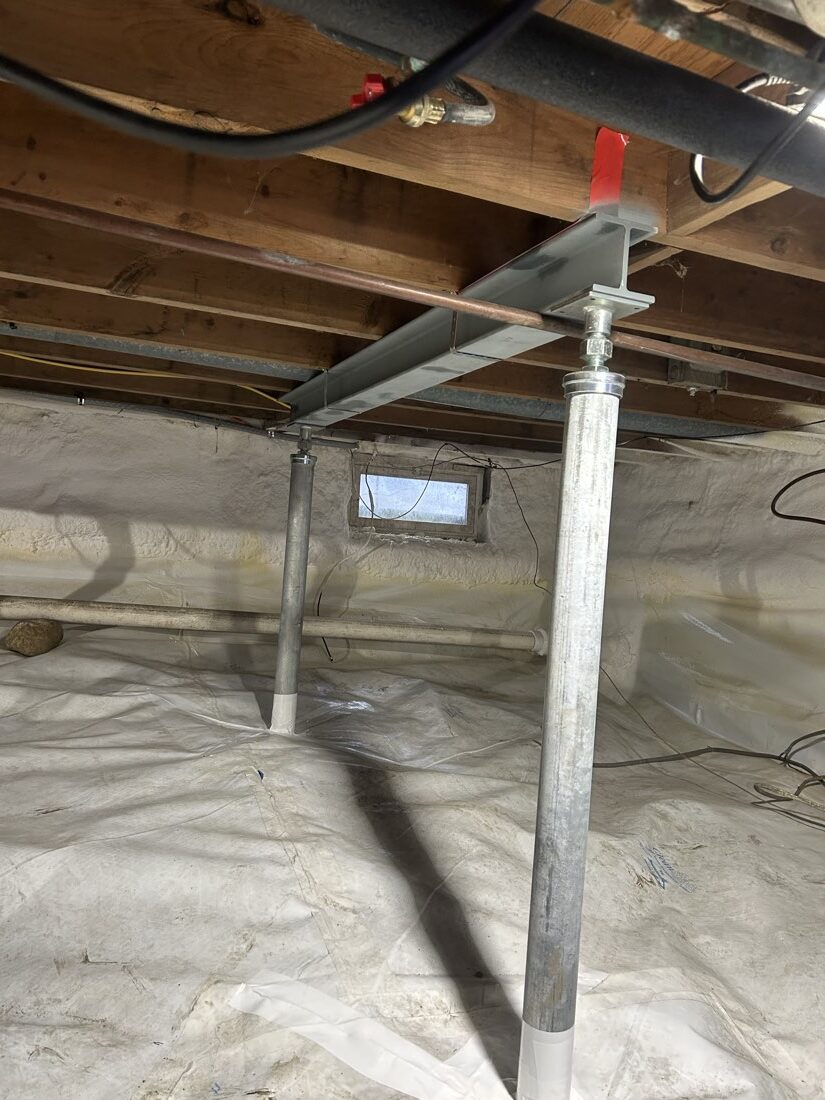
Crawl space work, sealed and dried out. These are different houses, not one job photographed start to finish.
Frequently asked questions
My basement is dry but the house still smells musty. Where’s that coming from?
Check under the back of the house. If part of it sits on a crawl, that’s the low point the house pulls its air from, and the smell is moisture in the insulation and the wood down there. A dry basement at the other end of the same building tells you nothing about it.
Isn’t a crawl space supposed to breathe? Why seal the vents?
The vents let warm humid summer air onto cool surfaces, and it condenses down there. In winter the melt off a plow bank runs in through the same openings. We build them sealed, and we confirm the requirement with your town before we start.
How much does crawl space encapsulation cost in Manchester?
$3,000 to $25,000. Access and headroom drive it, then whether the space needs drainage and a pump underneath the barrier. The inspection and the estimate are free and the written quote comes back inside 24 hours.
There’s already plastic down there. Am I covered?
Probably not. Loose plastic on dirt is a tarp with open seams and nothing up the walls. Encapsulation means the floor and the walls are sealed together, the seams are foamed, the vents are shut and the air is being dried. If yours is loose sheeting, you’ve got the cheap half of the job and none of the result.
Half my house is on a basement and the addition is on a crawl. Do you do both?
Yes. They’re two different systems on two different quotes. The basement gets interior drainage. The crawl gets encapsulated. One visit, and you’ll see both lines written out so you can do one now and one later if that’s what the budget says.
Does encapsulating the crawl take care of radon?
No. The liner slows soil gas down. Venting it takes a sub membrane system under the liner, priced separately. Test for $50 first, and we credit that toward the work if you proceed.
What a recent customer said
Gerald and his crew did an excellent job, first cleaning out all the debris and the dislodged insulation in the crawlspace. they were very communicative and understood my concerns and handled them professionally. When they were finished laying the sublayment and the top vinyl covering, carefully taping all the seams they put insulating foam around the perimeter, sealing the top of the vinyl. Gerald communicated two issues that were not part of the contract that I will subsequently take care of myself. Great job, very satisfied.
Alex C Arcisz, 5 stars, Google review
Book your free inspection today
Free inspection, free estimate, and a written quote in your hands within 24 hours.
Sources
Call volume: 603’s own CallRail record for the trailing 365 days (159 qualified Manchester calls). Foundation heat loss framing: US Department of Energy. The prices, the system spec and the warranty terms are 603’s own. Review text is quoted in full from the customer’s Google review.
Common questions about crawl spaces
- Can ‘dormant’ mold spores appear and affect a crawl space?
- Can I use plastic sheeting as a vapor barrier?
- Crawl space is infested with mold, how do we go about properly fixing it?
- Does crawl space encapsulation increase home value?
- Does encapsulating a crawl space really work and is it worth the money?
- How does a vapor barrier function?
- How imperative is it that a house is anchored to a crawl space?
- How much does it cost to encapsulate the crawl space for a 3,000 sq ft house? Is it worth it?
- How much wood moisture in your crawl space can you tolerate
- How to get rid of moisture in a crawl space
- I had my crawl space encapsulated and outside vents sealed. Why have my radon levels gone up?
- I was told of an add-on for my crawl space encapsulation: insulation under the 20 mil white casing. Is that preferred?
Manchester crawl space encapsulation — local context
If your Manchester crawl space is damp, musty, or open to bare soil, encapsulation seals it off for good. Manchester sits along the Merrimack River at Amoskeag Falls — a 55-foot drop the river makes right through the city center (Encyclopaedia Britannica) — so riverside and low-lying lots carry a high water table that drives moisture up into crawl spaces. The Amoskeag mills laid out the city and ran from 1838 to 1915 (Manchester Historic Association; Library of Congress HABS), leaving plenty of pre-1915 homes with dirt and fieldstone crawl spaces. Those open floors are also a radon path: Hillsborough County is EPA Radon Zone 2 (EPA), and New Hampshire's granite-bedrock radon runs roughly four times the national average (NH DHHS). Encapsulation = a 12-mil wall / 20-mil floor vapor barrier + dimpled drainage matting + dehumidifier + sump. Crawl space encapsulation runs $3,000–$25,000. Radon mitigation, if needed, is a separate add-on, typically $1,950–$2,250. See our crawl space services or radon mitigation.
What a recent customer said
"Gerald and his crew did an excellent job, first cleaning out all the debris and the dislodged insulation in the crawlspace. they were very communicative and understood my concerns and handled them professionally. When they were finished laying the sublayment and the top vinyl covering, carefully taping all the seams they put insulating foam around the perimeter, sealing the top of the vinyl. Gerald communicated two issues that were not part of the contract that I will subsequently take care of myself. Great job, very satisfied."
Frequently asked questions
Does my Manchester crawl space need radon mitigation along with encapsulation?
It might. Hillsborough County, where Manchester sits, is an EPA Radon Zone 2 (moderate potential, 2–4 pCi/L predicted), and New Hampshire's granite bedrock pushes statewide radon to roughly four times the national average (NH DHHS). The EPA notes elevated radon has been found in all zones and that every home should be tested. A dirt or fieldstone crawl space is a direct soil-gas entry path, so we recommend testing. Encapsulation seals the membrane; radon mitigation, if your test calls for it, is a separate add-on, typically $1,950–$2,250.
Why do older Manchester homes often have damp crawl spaces?
Manchester grew up around the Amoskeag mills, which laid out the city and operated from 1838 to 1915 (Library of Congress HABS; Manchester Historic Association). A large share of the housing stock dates from that mill era, the age of stone and fieldstone foundations with unconditioned dirt crawl spaces. Those open floors let ground moisture and humidity move freely. Encapsulation with a 12-mil wall / 20-mil floor vapor barrier, drainage matting, a dehumidifier, and a sump closes that off.
How much does crawl space encapsulation cost in Manchester?
Crawl space encapsulation runs $3,000–$25,000 depending on the size of the space, how much debris and old insulation needs clearing, and whether drainage and a sump are required. The system includes a 12-mil wall / 20-mil floor vapor barrier, dimpled drainage matting, a dehumidifier, and a sump. If a radon test comes back elevated — common in Hillsborough County's Zone 2 — mitigation is a separate add-on, typically $1,950–$2,250.