
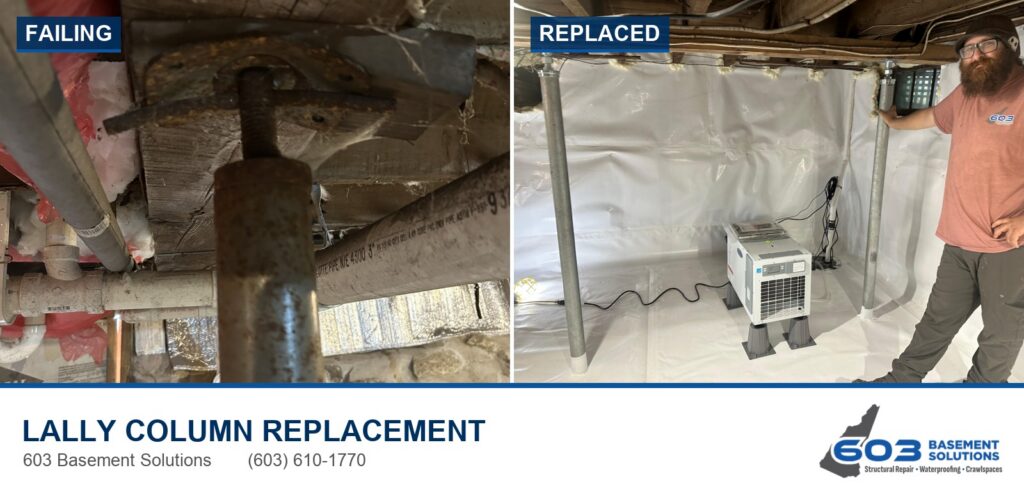
603 does not use one flat “support beam replacement” price because that phrase can describe three different repairs. Replacing a failed lally column under a sound beam runs $1,300 to $2,500 per column. Removing and rebuilding a rotted sill or beam section typically runs $7,000 to $30,000. A main center-beam repair is quoted after inspection because the beam length, load, access, footings, and temporary support all change the scope.
The useful first question is not “What does a beam cost?” It is “Which part of the load path has failed?” A new post cannot repair a rotted beam. A new beam cannot help if the footing below its post is settling.
Basement support costs by the part that failed
| Finding | Typical repair path | 603 pricing |
|---|---|---|
| One failed or badly corroded lally column | Replace the column and confirm the footing and beam connections | $1,300 to $2,500 per column |
| Rotted sill or beam material | Shore the load, remove failed wood, rebuild the section, and address moisture | $7,000 to $30,000 for typical 603 sill or beam work |
| Main center beam is split, undersized, or losing bearing | Repair, sister, or replace the beam and design the support below it | Quoted after inspection |
| Footing or foundation below the support is moving | Repair the bearing support before treating the beam as the whole problem | Depends on the designed footing or foundation repair |
These are 603’s current planning ranges. The written proposal controls the actual price and scope for the house.
Support beam, sill beam, joist, or lally column?
- Main support beam: usually runs through the basement or crawl space and carries floor joists inside the footprint.
- Sill beam or sill plate: sits on top of the foundation near the outside walls and carries the framing above.
- Floor joists: span from a wall or beam and support the subfloor.
- Lally columns or support posts: carry concentrated beam loads down to footings.
A low floor in the middle of a room may trace back to a beam or post. A soft floor along an outside wall can point toward sill or joist-end damage. Those are clues, not a diagnosis.
What changes the cost of a main support-beam job?
Beam length and material
A short localized repair is different from replacing a long built-up wood beam. Steel, engineered lumber, and dimensional-lumber assemblies also need different connections and handling.
The load above
The crew needs to know which walls, joists, stairs, masonry, or point loads bear on the beam. That determines the temporary support and the permanent repair.
The footing below
Every column needs a suitable base. A sound new post on an inadequate or moving footing leaves the load path incomplete. The quote should state what supports each new column.
Access and utilities
Ducts, plumbing, wiring, finished ceilings, stairs, and tight crawl-space access can change how the beam is shored, moved, and connected.
Rot and moisture
When moisture caused the failure, the repair needs to find and stop that water path. Otherwise the new wood is being installed into the same conditions that damaged the old material.
What a failed column can look like
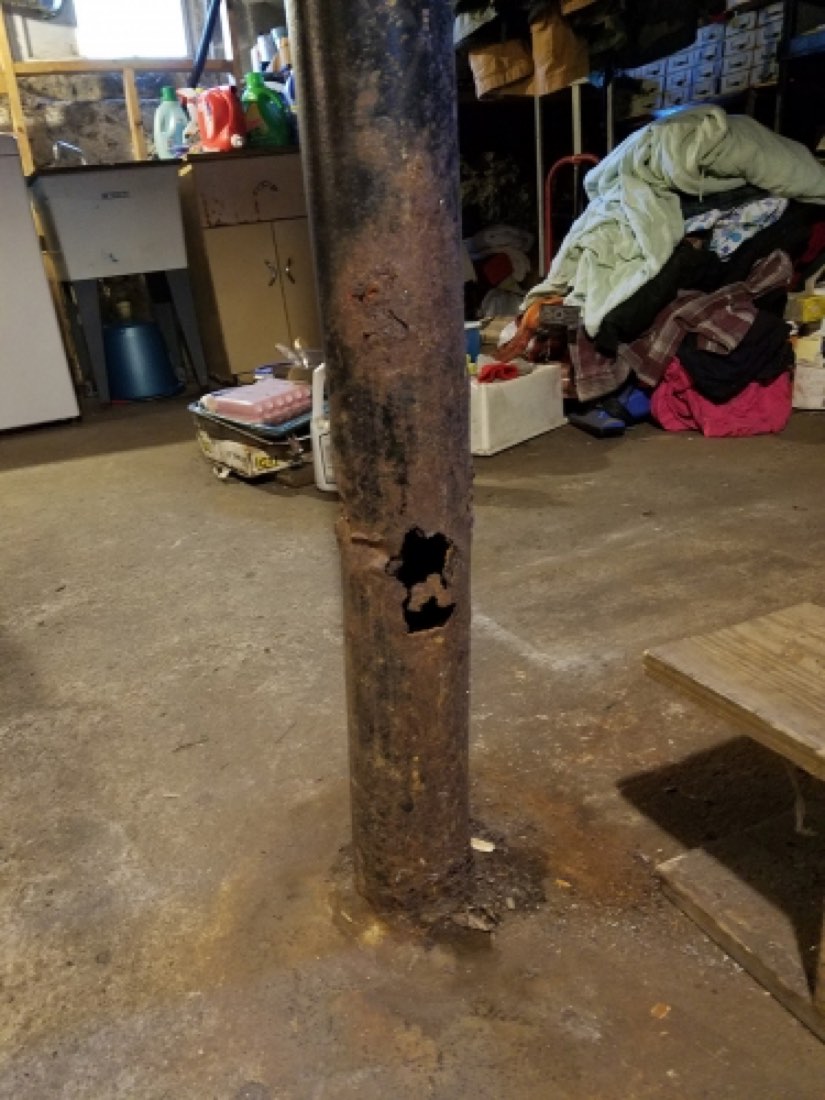
Rust at the bottom matters because that is where basement moisture often sits and where the column transfers load into its base. Surface rust and missing steel are not the same condition. If the column has holes, crushing, a loose top connection, or is visibly out of plumb, it deserves a closer look.
What a completed support repair can look like
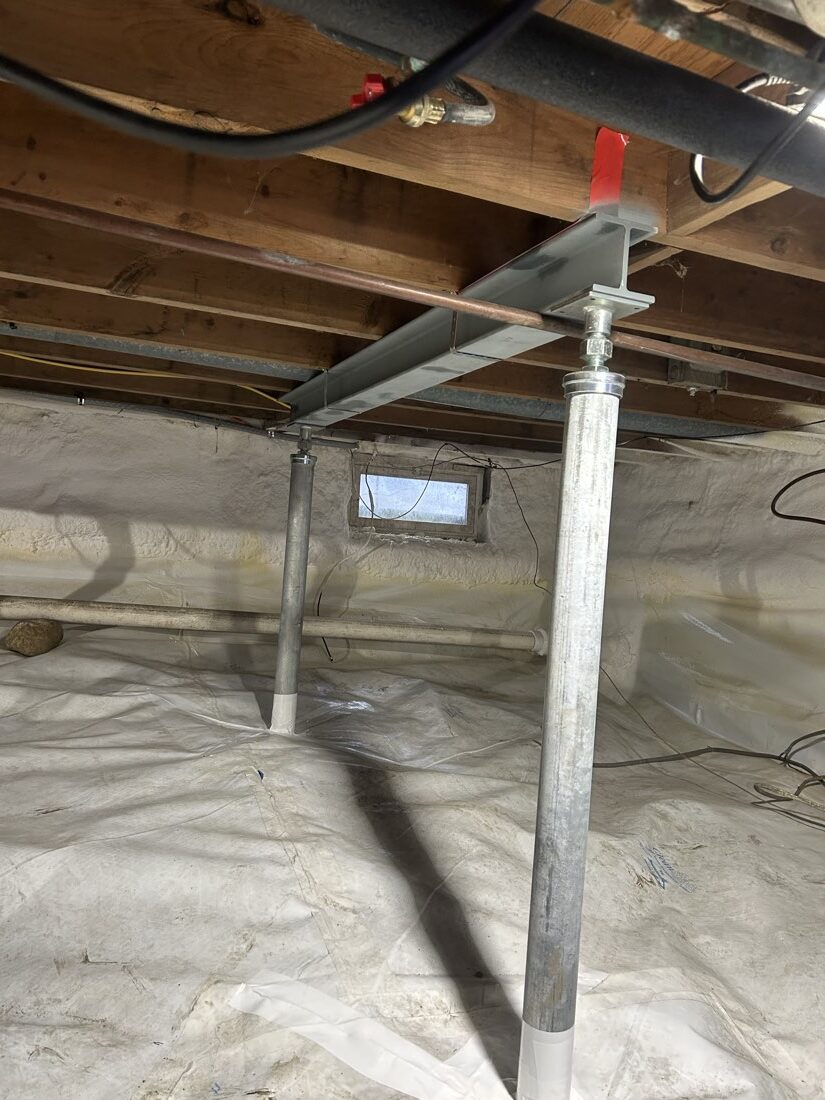
603 checks the beam line, column locations, top connections, and support below the slab. The visible post is only one part of the system.
Can a support beam be repaired instead of replaced?
Sometimes. A beam may be strengthened or sistered if the remaining material is sound and the design provides a complete connection. Localized damage may allow a section repair. A beam with widespread rot, a serious split, or inadequate bearing may need a larger replacement.
The proposal should name the method. “Fix beam” is not enough. It should say what stays, what comes out, what gets added, where the loads go, and whether another trade must remove or restore finishes.
Will a new column level the floor?
Not automatically. The first goal is to carry the load safely and stop further movement. Some floors can be adjusted toward level after the support is in place. Others have settled for too long, or have finishes and framing that should not be forced back in one move. The written scope should distinguish stabilization from an attempted lift.
What should a support-beam quote include?
- The failed beam, sill, joist, post, connection, or footing
- The temporary shoring plan while damaged material is removed
- The new beam or column material and its connections
- The footing or bearing detail under each support
- Any lift or floor adjustment included in the work
- Access, demolition, cleanup, and finish work included or excluded
- The warranty that applies to the completed scope

Emily Dillen
★★★★★ Google review
“Great company! We needed to replace the lally columns in our basement and they were able to knock out the whole job in under a week, Branden took the time to explain their process step by step and made me feel comfortable with what I thought was a very scary project. Highly recommend!”
Frequently asked questions
How much does a 20-foot load-bearing beam cost?
Length alone is not enough to price it. The material, load above, column spacing, footings, temporary shoring, access, and connections all matter. 603 prices a main beam after inspecting those parts rather than applying a generic per-foot number.
How long does a basement support beam last?
A sound beam can serve for decades if it stays dry and carries the load it was designed for. Water, insects, altered framing, overloaded spans, failed connections, and moving footings can shorten that life.
Can an adjustable post sit directly on the basement slab?
The load needs suitable bearing below it. A floor slab and a designed footing do different jobs. The repair plan should state what is below the new support rather than assuming the slab is enough.
Is a sagging floor always a beam problem?
No. The cause can be a beam, joist, sill, post, connection, footing, or more than one of them. Measuring the floor and following the load path prevents the wrong part from being replaced.
Seeing a sagging floor, damaged beam, or rusted support column?
603 will trace the load from the floor framing to the footing and give you a written scope. See our supplemental support service, sill and beam replacement, or lally column cost guide.