
Quick Answer
For a changing wall, floor, or support, 603 Basement Solutions provides foundation repair in Dedham, Massachusetts for movement below the footing, pressure on basement walls, floor sag, failing posts, and timber decay. Repairs are selected from the evidence and can include piering, wall stabilization, interior support, sill or beam work, crack repair, or a watch-and-measure plan. The next step is a free inspection followed by a written estimate.
Make the old repair understandable before adding a new one
An invoice, patched crack, added post, or old brace tells us that someone worked in the basement. It may not tell us exactly where, why, or whether the same concern is active now.
We inspect the current structure first and match earlier work to a location when the evidence allows it. Sound work can stay.
What Dedham’s townwide housing number can tell us
The 2023 American Community Survey places Dedham’s median housing year at 1955. That townwide estimate cannot date one house, alteration, or repair.
Use the property’s own invoices, plans, permits, warranties, and photographs when they can be tied to a visible wall or support. Unknown history can remain unknown.
Foundation Problems, Inspection Points, and Possible Repairs in Dedham
| What you are seeing | What 603 inspects | Possible repair |
|---|---|---|
| A chimney or supported projection is pulling from the house | Test whether the visible changes align with a loss of support at the footing | Helical or push piers may be designed where competent bearing is needed |
| Blocks or poured concrete no longer remain in plane | Map the wall movement and inspect cracks, construction type, and outside conditions | A sized brace or reinforcement may stabilize the affected wall |
| A beam end or sill has lost sound material | Compare floor elevations with beam bearing, columns, sills, and concrete below | Supplemental support may fit when the existing beam line is inadequate |
| A vertical, horizontal, or stair-step line raises concern | Read the pattern in context with the rest of the foundation and structure | Focused crack repair may fit after structural movement is ruled out |
The possible-repair column does not prescribe work for a Dedham property.
Typical Foundation Repair Pricing
Current helical-pier pricing gives homeowners a commercial reference point. For current foundation-repair work, 603 prices the first, second, and third helical piers at $2,700 each. Later piers are $2,200 apiece, while a typical Massachusetts structural piering project costs $12,000 to $18,000 or more.
Other methods depend on wall length, access, materials, support layout, and the intended result. See the helical pier cost guide for worked pier-count examples; the free Dedham inspection supplies the actual written scope.
Start with what you can see
A patch has not changed
Keep it visible and compare current wall measurements.
An old post looks different
Check its load, connections, and bearing before replacing it.
A warranty names a system
Match it to the actual treated wall or component.
A new symptom sits nearby
Measure it separately before linking it to the old repair.
Judge older work by what it is doing now
We check connections, bearing, wall shape, floor readings, and change over time. Appearance and age are not enough to call a repair failed.
If the older component is sound, keeping it may be the most sensible choice. New work belongs only where the current load path needs it.
Give each repair a plain location
A room name, wall length, nearby opening, and wide photograph can make an old invoice useful. We tie close details back to that simple view.
Any new proposal should use the same locations. That lets you compare what stays, what changes, and where the new warranty applies.
Keep the remaining conditions visible
An old slope, cosmetic crack, stain, or untouched support does not disappear because one section was repaired.
We state what remains and what, if anything, should be watched. That is more useful to a homeowner than a thick file that makes the whole basement sound treated.
Old paperwork helps only when it points to the repair
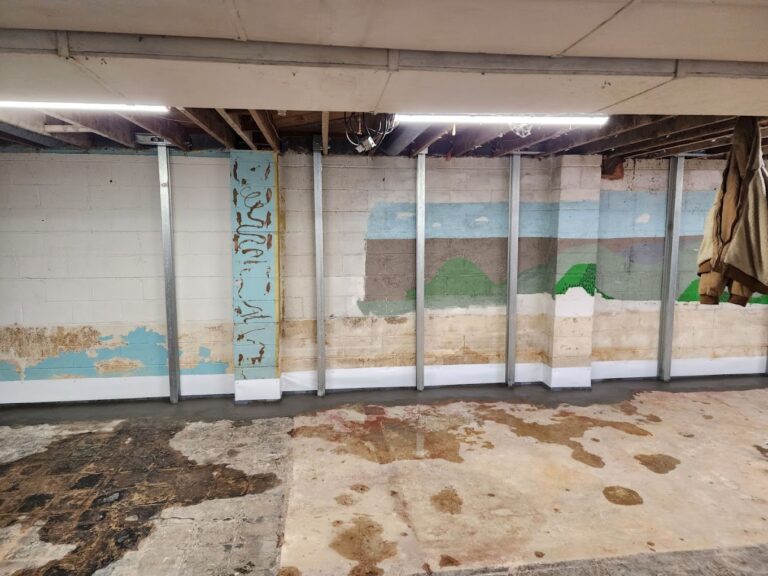
If you have an invoice for foundation work, look for a drawing, room name, wall length, or labeled photographs. A system name and dollar amount do not show which part of the house was treated. Keep patches and older components visible during the inspection.
We can compare that material with what is in the basement now. We do not assume an old crack, post, or brace belongs to the same concern simply because it is nearby.
What a patched crack or replaced post may mean today
The earlier repair may still be doing its job while a different condition has appeared. It may also lack a connection or support that needs attention. Current measurements decide that; the age or appearance of the work does not.
If the structure is sound, leaving the older work in place and taking a few baseline photos may be better than replacing usable work. If a new repair is needed, its limits should be easy for a future owner to understand.
What we check and show a Dedham homeowner
We locate each concern on a simple drawing and connect it to measurements, wide photographs, and close details. We check walls, beams, posts, bases, bearing, floor changes, and openings related to the symptom.
After work, the same locations should show what was installed, what remains, and what the warranty covers. You should not need contractor memory to explain the repair during a future sale or renovation.
When a simple baseline is enough
A stable old patch, secure post, or unchanged slope may only need a useful baseline. We can identify a few points to photograph or measure again without treating every visible repair as a failure.
Call sooner if an older component loosens, a crack grows beyond its patch, a beam loses bearing, or doors and floors change rapidly. Save original files and reports; screenshots often lose the location and scale that make them useful.
Build a simple Dedham before-picture
Start with one drawing of the basement and label the wall, beam, post, or footing section that concerns you. Add wide photographs and any older invoice that can be tied to the same location.
Do not discard older repair parts or paperwork simply because a new estimate is being considered. They may show what was changed, what remained, and where a warranty begins or ends.
Write down which clues are active now: a growing crack, a changing door, a loose post, or a floor that recently shifted. Stable older marks can stay on the drawing without being sold as new work.
A simple sketch and matched photos are useful now, not only at resale. They help you compare proposals, avoid drilling into a repaired area, and show another contractor what remains outside the work. A few clear pages are usually more helpful than a thick folder with no map.
If a warranty transfers, keep the original terms with a matching room sketch rather than relying on a website summary. The paper may cover one wall, one beam, or specific installed components. We can help you match visible work to that boundary, but we do not rewrite another contractor’s promise. The goal is to understand what remains protected and what a new proposal would treat separately.
Read the Dedham slab without erasing the older repair
An old patch can cross a basement floor surface without telling us whether a building-supporting slab moved. We preserve its edges and document the current Dedham condition. Measurable displacement, renewed crack change, and related movement at a loaded component can identify an active structural section. Stable evidence may support monitoring or a focused repair; a confirmed load-path problem may lead to stabilization or replacement. The current scope receives its own dated layer and endpoints. Slab foundation repair fits when the supporting concrete itself is involved. Earlier work remains visible as history rather than diagnosis.
If the wall is moving inward
We measure the full wall before choosing braces or straps. Power braces cost $1,300 each and carbon-fiber straps cost $850 through 603. The treated wall carries a 25-year warranty within the stated limits. A stable leaking crack may need a smaller crack-repair scope instead.
If the floor or beam needs support
We follow the Dedham floor load through joists and beam to the post base and bearing below. A new column is useful only when it sits under the load that needs help. 603 lally columns usually cost $1,300 to $2,500 each, and the treated support area has a 10-year settlement warranty.
If the footing section needs support
How pier selection fits this finding. A prior Dedham repair stays in the property record while new footing settlement is evaluated. If piers are warranted, push piers use the existing building as reaction during installation, whereas helical piers advance by their helical plates. Available building weight, footing condition, access, and the new design determine the choice. The earlier patch should not silently define the current pier boundary or become part of the new warranty.
Before your Dedham inspection
- Gather what is easy. Bring invoices, warranties, photos, or plans that can be tied to the basement.
- Leave repairs visible. Do not remove braces, posts, patches, or labels before inspection.
- Name the new change. Separate an active symptom from older marks that look the same.
- Ask what can stay. A sound older component does not need replacement for appearance alone.
Dedham foundation questions
Does an old invoice prove the area was repaired?
Only when it can be matched to a location or component.
Should every old post be replaced?
No. We check its load, connections, condition, and bearing.
Can a stable patch remain?
Yes. It can be photographed and watched when the wall is sound.
What should I keep after the repair?
Keep the room or wall location, measurements, photos, completed work, and warranty.
What 603 documents during a Dedham structural inspection
The decision begins with this page’s central issue: Make the old repair understandable before adding a new one. The crew maps that observation to the connected wall, footing, beam, post, or floor before a repair enters the proposal.
603 is licensed and insured and has worked in more than 5,000 homes. Its own crews install helical piers and perform structural lifting. The inspection and estimate cost nothing; the written quote normally follows within 24 hours and identifies the treated area, quantities, intended result, exclusions, and warranty.
Why Homeowners Choose 603 for Foundation Repair
A foundation proposal needs trust as well as measurements; the evidence below shows how 603 follows through for homeowners around Dedham.
Get the Dedham load path checked
Your Dedham visit will connect the measurements to a defined repair boundary and a written scope that can be checked against the house.
Sources: U.S. Census Bureau, 2023 ACS 5-year table B25035. The city image caption links its Wikimedia Commons source and license. 603 supplied the confirmed service, pricing, warranty, and operating information. Work imagery shows a 603 repair method. See Structural and Foundation Repair or the Foundation Crack Repair service.