
Quick Answer
Broad foundation repair from 603 Basement Solutions covers more than crack sealing in Everett, Massachusetts for movement below the footing, pressure on basement walls, floor sag, failing posts, and timber decay. The measured condition may lead to pier support, wall stabilization, column or framing work, sill replacement, a crack-specific repair, or monitoring. The next step is a free inspection followed by a written estimate.
Begin with what changed, and leave the unknowns honest
A new crack, lower floor, sticky door, or loose support gives us a starting point. It does not automatically name the cause or the repair.
We measure what is visible, follow the load, and tell you when one hidden connection still matters. We do not turn that hidden area into certainty.
What Everett’s townwide housing number can tell us
The 2023 American Community Survey places Everett’s median housing year at 1938. That citywide midpoint does not identify materials or concealed conditions at one address.
Bring observations from the property itself: when the symptom appeared, what changed with it, and any older photograph that shows the same room or wall.

Foundation Problems, Inspection Points, and Possible Repairs in Everett
| What you are seeing | What 603 inspects | Possible repair |
|---|---|---|
| Floors and trim changed above the same footing section | Test whether the visible changes align with a loss of support at the footing | Helical or push piers may be designed where competent bearing is needed |
| Blocks or poured concrete no longer remain in plane | Inspect how the wall is built and what is acting on it from outside | Repair may focus on restraint, drainage, rebuilding, or a combination |
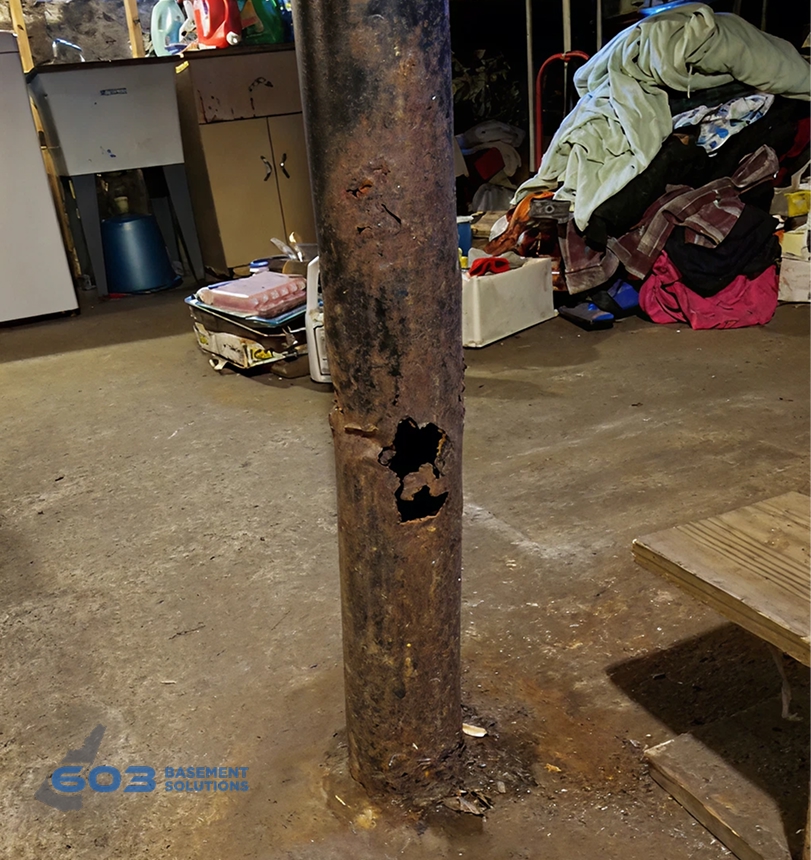
| Doors bind above a low support line | Inspect structural wood, post condition, connections, and the base carrying each support | Column, beam, sill, or footing work may restore the support path |
| A fieldstone joint is losing mortar or admitting water | Separate water entry from movement by checking the wall and connected loads | Repointing, drainage, or stabilization answer different fieldstone conditions |
Only the measurements at the Everett inspection can set the scope.
Typical Foundation Repair Pricing
603 publishes a method-specific price for structural helical piers. Three existing-foundation helical piers price at $2,700 each under 603’s current schedule. The rate becomes $2,200 for each additional pier; typical Massachusetts structural piering is $12,000 to $18,000 or more.
A city page cannot substitute for measurements, quantities, access, and a defined outcome. See the helical pier cost guide for worked pier-count examples; the free Everett inspection supplies the actual written scope.
Start with what you can see
A crack ends behind a pipe
Mark both visible ends instead of guessing through the hidden part.
A door changed this month
Check the floor and framing below before adjusting it.
An old repair sits nearby
Inspect its current connection without inventing its history.
The beam end is covered
Use one small opening only if that view changes the decision.
Use the wide view before the close-up
A crack detail matters more when we can place it on the full wall. The same is true for a post, beam end, or floor gap.
We give rooms and walls plain names and use them in the measurements and photos. You should be able to follow the explanation without a technical key.
Say what cannot yet be seen
Finish, utilities, or an earlier repair may hide the connection that owns the symptom. We identify that limit rather than guessing past it.
The next step can be a targeted opening, a repeat reading, or no action. It depends on whether the missing view would change a repair recommendation.
Show new information before changing the work
If an opened area reveals something different, we stop at that part and show you. We explain what the new condition means and what options remain.
A revised recommendation should still answer the same homeowner question. It should say what needs help, what can stay, and what result the added work is expected to provide.
Start with one sentence about what changed
Tell us what you see now that you did not see before. It may be a new crack, a wider gap, a lower-feeling floor, a sticking door, or a post that no longer sits square. Add roughly when you first noticed it and whether it changed after rain or renovation.
That short history gives us a place to begin. It is more useful than trying to name the repair yourself, because several different structural and water problems can leave similar marks.
What an Everett inspection can and cannot answer
Accessible measurements may be enough to show that a wall is stable, a beam needs support, or a footing section deserves a closer look. Finished surfaces can sometimes hide the one connection needed for a final recommendation.
When that happens, we explain the unknown plainly. We do not turn a hidden condition into a confident diagnosis. The next step might be a small opening, a second reading, or no work until there is evidence of change.
What 603 checks in the room and below it
We follow the symptom across the floor and into stable areas. We check wall shape, joist direction, beam ends, posts, bases, visible bearing, cracks, patches, and nearby utilities. Wide photographs keep each detail tied to its actual location.
If the exposed condition differs from what was visible during the estimate, we stop and show you before changing the work. You should understand what was found, why it matters, and what a revised repair would accomplish.
When more information is better than more work in Everett
Watching may be appropriate when the structure is supported, readings do not show active movement, and the symptom is not worsening. Dated crack photos or a small elevation map can give the next visit a real comparison.
Call sooner if bearing is lost, a post leans, a wall moves inward, or a crack and door change rapidly together. Avoid fresh patching or adjustment before the visit so the original evidence remains visible.
Bring the change, not a theory
A note such as ‘this door started sticking in August’ is useful. A guess that the entire foundation is sinking is not required. Photograph the door, nearby floor, and basement structure below it so we can test the connection.
Leave patches, cracks, shims, and posts unchanged. If a concealed connection becomes the only unanswered question, we will point to the exact location and explain how seeing it would change the recommendation.
Old inspection photos can show whether a line existed before. Keep the widest version as well as the close-up. Without the surrounding wall or room, a detailed image is difficult to compare later.
The useful answer can be short: the structure is stable, take another reading later, or repair this named area. If a hidden connection prevents that answer, we identify the gap instead of filling it with assumptions. You should leave knowing what is certain and what is not.
When a crack disappears behind a pipe or finished wall, mark both visible ends and photograph their surroundings. Do not draw a straight line through the hidden section and call it continuous. We inspect each visible part and label the missing view. The unseen section could change direction, end, or belong to a different joint. The repair should not rely on a line nobody observed.
Keep the unknown edge of an Everett slab visible
A utility may interrupt the view of a crack without changing what the concrete carries. In Everett, we label the visible floor surface, any supporting slab, and the hidden interval separately. Displacement at exposed endpoints, change over time, and related movement in a wall or loaded component help decide whether a focused opening is justified. The inspection can then choose monitoring, focused crack repair, stabilization, or replacement without bridging the hidden area with a guess. The slab foundation repair service belongs in the scope only when the recovered evidence identifies the load-supporting concrete as the moving component.
If the floor or beam needs support
We follow the Everett floor load through joists and beam to the post base and bearing below. A new column is useful only when it sits under the load that needs help. 603 lally columns usually cost $1,300 to $2,500 each, and the treated support area has a 10-year settlement warranty.
If the wall is moving inward
We measure the full wall before choosing braces or straps. Power braces cost $1,300 each and carbon-fiber straps cost $850 through 603. The treated wall carries a 25-year warranty within the stated limits. A stable leaking crack may need a smaller crack-repair scope instead.
If the footing section needs support
How pier selection fits this finding. A crack disappearing behind an Everett pipe leaves an unknown, not a pier diagnosis. If complete measurements later confirm footing settlement, push piers use the existing structure for reaction during installation, while helical piers advance through helical plates. House weight, footing condition, access, and the written design determine the choice. A targeted opening should resolve the missing connection before a pier location or quantity is promised.
Before your Everett inspection
- Write one change. Describe the new crack, gap, door, floor, or support in ordinary language.
- Add a room view. Photograph enough of the area that the close detail can be found again.
- Leave hidden work hidden. Do not cut finish until measurements show the missing view matters.
- Keep old evidence. Save prior photos and leave patches or repairs visible for comparison.
Everett foundation questions
Can you diagnose everything without opening a wall?
Often we can narrow the answer, but one connection may still need a targeted view.
What if the hidden condition is different?
We stop, explain it, and discuss the choices before changing the work.
Does an old patch prove continuing movement?
No. Current measurements and change over time matter.
When is monitoring useful?
When supports are sound and repeatable readings show no active change.
What 603 documents during a Everett structural inspection
The decision begins with this page’s central issue: Begin with what changed, and leave the unknowns honest. The crew maps that observation to the connected wall, footing, beam, post, or floor before a repair enters the proposal.
603 is licensed and insured and has worked in more than 5,000 homes. Its own crews install helical piers and perform structural lifting. The inspection and estimate cost nothing; the written quote normally follows within 24 hours and identifies the treated area, quantities, intended result, exclusions, and warranty.
Why Homeowners Choose 603 for Foundation Repair
603’s customer feedback and field documentation below give Everett owners concrete evidence to weigh with the written scope.
Get the Everett load path checked
Your Everett visit will connect the measurements to a defined repair boundary and a written scope that can be checked against the house.
Sources: U.S. Census Bureau, 2023 ACS 5-year table B25035. The city image caption links its Wikimedia Commons source and license. 603 supplied the confirmed service, pricing, warranty, and operating information. Work imagery shows a 603 repair method. See Structural and Foundation Repair or the Foundation Crack Repair service.