
Quick Answer
Broad foundation repair from 603 Basement Solutions covers more than crack sealing in Exeter, New Hampshire for dropping footings, inward-moving walls, low beam lines, compromised posts, and structural wood loss. The measured condition may lead to pier support, wall stabilization, column or framing work, sill replacement, a crack-specific repair, or monitoring. The next step is a free inspection followed by a written estimate.
Exeter has two very different foundation conversations
If the wall is masonry or fieldstone
Loose mortar, displaced stone, sill deterioration, and altered floor supports require an inspection of the actual assembly. An injection meant for poured concrete is not a restoration plan for a masonry wall.
If the wall is poured concrete or block
We separate a stable crack from wall movement or foundation settlement before choosing a targeted repair. The material is confirmed on site, not predicted from the neighborhood.
Exeter’s median housing unit was built in 1978, while about 22% of its housing units predate 1940, according to the 2023 ACS. We do not use either figure to diagnose a house. They reinforce why two inspections in the same town can produce different scopes.
Bring any old repair invoices or engineering notes you have. On a house that has changed hands several times, those records can explain whether a steel post, patched wall, or sistered beam was a permanent repair, a temporary support, or work done for an earlier problem. That context is more useful than guessing from how new the material looks.
Start at the top of the support system
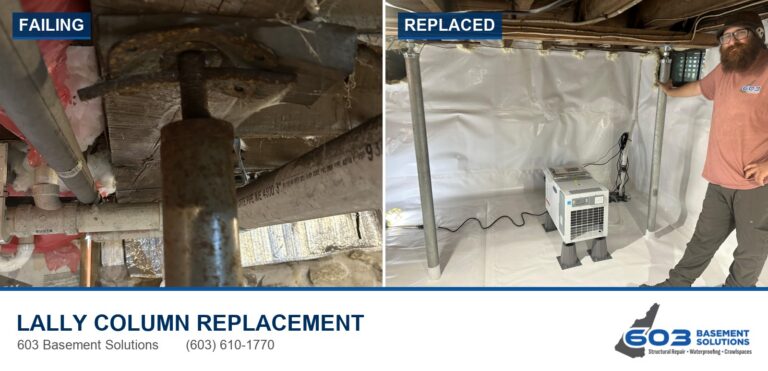
A failed or poorly based steel post belongs in the lally column replacement path after the beam and footing are checked together.
If the floor is sagging, we do not jump straight to a new post. The beam may be undersized or damaged. The sill at the outside wall may have lost material. The old column footing may not be doing its job. Or the foundation below the whole assembly may be moving. Each layer has to be checked in order.
For verified support work, lally-column replacement runs $1,300–$2,500 and carries a 10-year warranty against further settlement in treated areas. Sill replacement is scoped separately because access and the length of damaged wood change the work.
Foundation Problems, Inspection Points, and Possible Repairs in Exeter
| What you are seeing | What 603 inspects | Possible repair |
|---|---|---|
| Cracks and openings are changing near one settled area | Follow the settled section from rooms above to its contact with the ground | Stabilization below the footing may apply to the measured section |
| One foundation wall has changed shape under outside pressure | Compare the wall face, top, corners, and exterior sources of pressure | The measured wall condition determines the stabilization method |
| Joists deflect where they meet a beam, wall, or support | Trace joists through beams, posts, connections, and supporting footings | Unsound structural wood can be replaced in a planned support sequence |
| An earlier patch opened again while nearby finishes stayed stable | Compare the repaired area with measurements from adjacent walls and floors | Focused crack repair may fit after structural movement is ruled out |
603 confirms the failed component before pricing work at a Exeter property.
What Happens During Your Exeter Foundation Inspection
- Document the location, direction, and pattern of the reported change.
- Follow the affected wall or floor to each bearing point below it.
- Compare plausible causes and rule out work the evidence does not support.
- Define the treated area and expected outcome in a written proposal.
Why Homeowners Choose 603 for Foundation Repair
A foundation proposal needs trust as well as measurements; the evidence below shows how 603 follows through for homeowners around Exeter.
When the wall itself is the issue
A wall that is moving inward needs stabilization, not a skim coat. 603 uses carbon-fiber straps or power braces where the design calls for them. Confirmed prices are $850 per carbon-fiber strap and $1,300 per power brace. The wall-stabilization warranty is 25 years for further inward movement within design tolerances.
A wall that is crumbling, displaced, or unable to carry the structure safely may need a different repair or replacement scope. We keep that pricing quote-based instead of pretending one online range covers every wall.
When settlement points to piers
A dropping corner, continuing level change, and related cracking can point to footing settlement. When that is the cause, 603 installs helical piers in-house. They are priced at $2,700 each for the first three and $2,200 each after that and carry a 25-year engineered-performance warranty.
Footing settlement can be supported in more than one way. Push piers are hydraulically advanced against an existing structure, while helical piers are rotated into the ground and checked by installation torque. We inspect the footing material and condition, the weight being supported, equipment access, and the repair objective before selecting a system. If those conditions do not support piering, the scope should stay with the wall, crack, wood, or interior support that actually failed.
The inspection still comes first. A crack is not automatic evidence that a pier is needed. When the wall is stable and the issue is limited to one crack, foundation crack repair in Exeter may be the appropriate scope.
When concrete movement extends beyond one crack
A line in a basement floor does not tell us whether the slab is structural. We check for a height difference across it, continued change after patching, and movement that also appears at walls, partitions, or openings. If the concrete is only a floor surface, the repair remains different from work on a slab carrying the building. The inspection can support monitoring, targeted crack repair, stabilization, or replacement where the slab itself has failed. Review the distinctions on our slab foundation repair page.
What happens after you call
The inspection and estimate are free. We look at the symptoms, take the measurements the repair requires, explain the options without pressure, and send the written quote within 24 hours. If the right answer is a narrow crack repair, we say so. If the structure needs a larger plan, the proposal separates the repair methods and warranties.
Foundation Repair Questions from Exeter Homeowners
Can every old Exeter foundation be repaired the same way?
No. Wall material, support above it, current movement, and access decide the method. Age is context, not the diagnosis.
Do you replace lally columns without checking the beam?
No. The new support is only useful if the beam, sill, footing, and load it carries are part of the inspection.
What if it is only a leaking crack?
If the wall is stable, injection may be enough. The inspection checks for movement before the repair is selected.
Where does the Exeter crew travel from?
603 serves Exeter from its East Kingston shop.
Review the complete service at Structural and Foundation Repair, read the foundation cost decision guide, or find Exeter on the service-area map.
How to compare foundation proposals in Exeter
Start by comparing the diagnosis, not the total. One contractor may be pricing a crack repair while another is pricing wall stabilization or floor support. Those are not competing versions of the same job. The written proposal should identify the failing component, the proposed method, the quantity or treated length, access assumptions, cleanup, and the warranty attached to the work.
The 2023 American Community Survey puts Exeter’s median housing year at 1978 and reports that 22.0% of housing units were built in 1939 or earlier. A housing date cannot tell you whether one home has fieldstone, block, poured concrete, or a later addition. It only reinforces the need to inspect the material and support layout rather than applying a townwide assumption.
If the proposal says “stabilize”
Ask what movement was measured, what system resists it, how many braces, straps, or piers are included, and what area the warranty covers.
If the proposal says “replace”
Ask which material is beyond repair, how temporary support will be handled, what adjoining components were checked, and whether engineering or a permit belongs in the scope.
603’s proof is method-specific
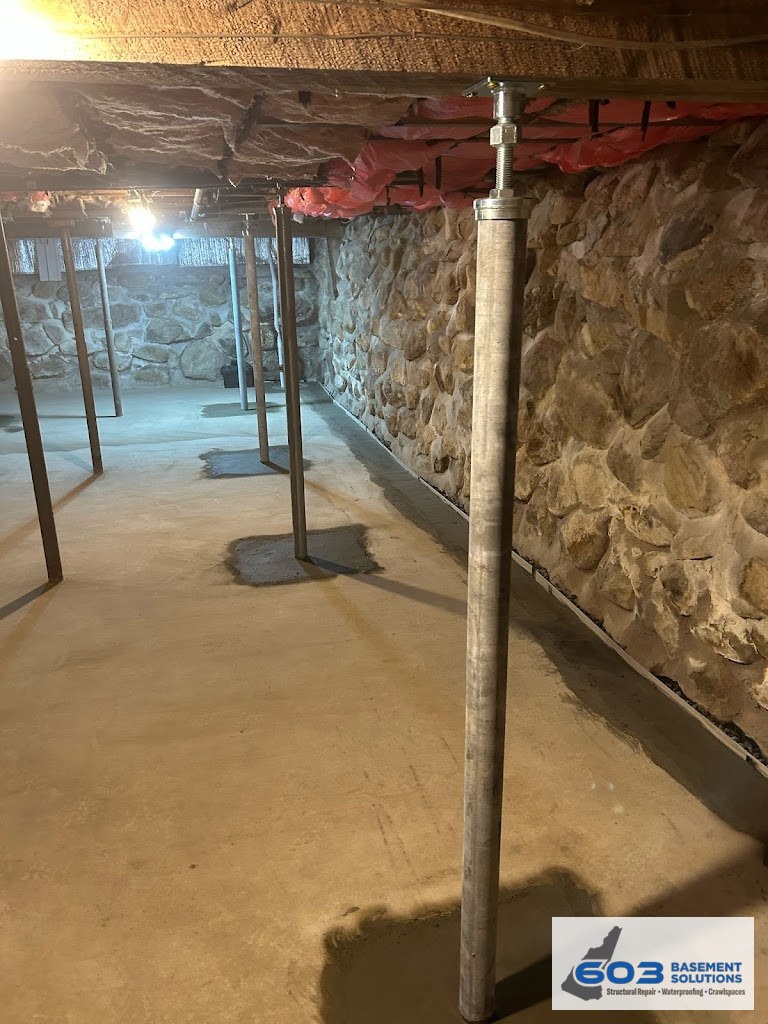
The work photographs on this page come from 603’s structural portfolio. They show column, footing, wall-brace, sill, and helical-pier installation methods. The company self-performs helical-pier work, is licensed and insured, and has served 5,000+ New England homeowners.
Method proof also needs a boundary. A photograph can show how a footing, column, brace, or pier is installed, but it cannot establish the material or failure at your address. The free inspection connects the visible condition to the repair; the written proposal records that connection.
The last questions before you sign
- Is the repair designed to stop movement, recover position where possible, replace damaged material, or only seal water?
- What part of the job is priced by unit, such as a pier, brace, strap, or column?
- What conditions could change the price after work begins?
- Who handles any engineering or municipal review the proposed scope requires?
- What photographs, measurements, and warranty documents will you receive when the job is complete?
603’s inspection and estimate are free, and the written quote normally follows within 24 hours. Confirmed starting points include $1,300–$2,500 for a lally-column replacement, $850 per carbon-fiber strap, $1,300 per power brace, and $2,700 each for the first three helical piers with later piers at $2,200 each. These are decision ranges, not a substitute for the measured scope.
Exeter foundation questions worth answering on paper
What if the wall material changes along the basement?
Document each section. Additions and earlier repairs can create different materials and support details in one house. The proposal should state which area is being treated rather than using one description for the entire perimeter.
Can a new column repair a damaged sill?
A column may provide temporary or permanent support at a designed point, but it does not replace deteriorated wood at the perimeter. The sill, beam, post, connection, and footing must be evaluated as a system before the repair is selected.
What does the free inspection produce?
You should leave the decision with a clear explanation of the finding and receive a written estimate, normally within 24 hours. The scope should identify the method, quantity, price, and warranty rather than relying on a verbal description of “foundation work.”
When booking, mention if the visible condition crosses from one foundation material or addition into another. Photograph both sides of that transition and any support directly above it. The repair may need one coordinated plan, but the inspector should not assume that the same method belongs on both sections.
Find the failed part before pricing the fix
Free inspection. Free estimate. Written quote within 24 hours.
Sources: U.S. Census ACS 2023 5-year tables B25035 and B25034; 603 confirmed service, pricing, and warranty information; public Google review. Work photos show 603 repair methods.