
Quick Answer
A foundation repair visit from 603 Basement Solutions starts with diagnosis in Hampton, New Hampshire for settlement, inward wall movement, uneven floors, failed columns, and damaged sills or beams. Depending on the findings, 603 may recommend helical or push piers, wall reinforcement, floor support, structural wood replacement, crack repair, or observation. The on-site inspection and written estimate are free.
What changed, and how fast?
A door that has always stuck is different from one that stopped closing this month. A hairline crack that has looked the same for ten years is different from one that grew past a pencil mark over winter. A wall that only looks rough is different from one that measures farther inward at the top than at the bottom.
Hampton’s median housing unit was built in 1978, yet that townwide number cannot identify the wall material or support system under one address. We document actual movement instead of treating every old mark as an emergency. A stable crack may only need targeted crack repair; a dropping floor, leaning wall, or damaged sill calls for a wider structural inspection.
How we narrow a structural problem
Foundation Problems, Inspection Points, and Possible Repairs in Hampton
| What you are seeing | What 603 inspects | Possible repair |
|---|---|---|
| One wall line no longer matches earlier elevations | Compare elevations and trace loads into the footing below | Deep pier support may fit if the measurements confirm bearing failure |
| A stair-step pattern appears with wall displacement | Compare the wall face, top, corners, and exterior sources of pressure | Carbon fiber, steel bracing, or another designed system may apply |
| Joists deflect where they meet a beam, wall, or support | Follow the load from the changed room to every interior support point | Unsound structural wood can be replaced in a planned support sequence |
| An earlier patch opened again while nearby finishes stayed stable | Determine whether the slab carries load and how its edges are supported | Injection or sealing may apply when the wall remains stable |
Possible does not mean required; the site findings control the recommendation.
If the wall is bowing
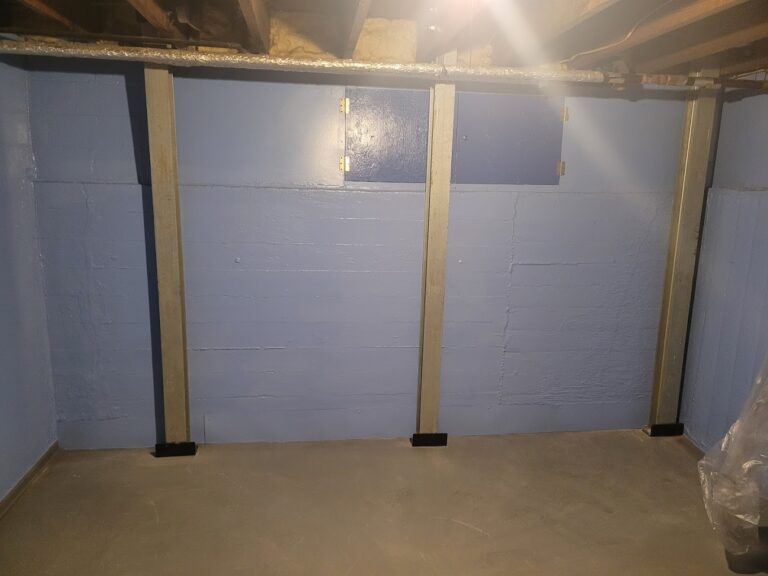
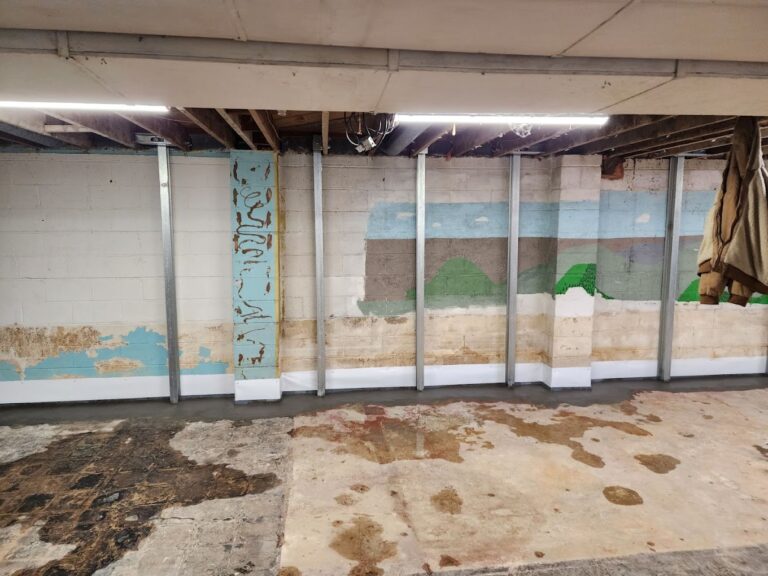
Do not cover it with a finished wall and hope it stays put. We measure the movement and evaluate the material and access. Depending on the design, the repair may use carbon-fiber straps at $850 each or power braces at $1,300 per brace. Wall stabilization carries a 25-year warranty against further inward movement within the system’s design tolerances.
The service explanation is on our Bowing Foundation Wall Brace page. We keep wall-replacement pricing qualitative until we have inspected it because demolition, access, temporary support, and engineering can change the job.
Why Homeowners Choose 603 for Foundation Repair
The proof below gives Hampton homeowners a direct view of 603’s service, explanations, and completed structural work.
Foundation Repair Methods and Pricing in Hampton
House sinking? Piers are the solution when the inspection confirms footing settlement. 603 self-performs helical installations in-house. Pricing is $2,700 per pier for the first three and $2,200 per pier after that, with a 25-year engineered-performance warranty. A real design is based on the structure and required pier count, not a city-page estimate.
Once footing settlement is verified, we still have to choose the right underpinning system. Push piers use an existing building’s weight as the reaction force while the sections are hydraulically advanced. Helical piers are rotated to the designed bearing criteria. Footing strength, building weight, access, soil response, and the intended repair all matter. A pier recommendation should state why that system fits the house instead of treating both methods as interchangeable.
Read how the method works on the helical piers page and compare cost factors in the helical-pier cost guide.
If the floor feels wrong
If the weak point is the steel support and its footing, see how lally column replacement is scoped before assuming the whole foundation moved.
A soft or sloping floor can start with a column, the beam it carries, the sill at the wall, or a combination. Replacing only the most obvious post can leave the damaged member above it untouched. Lally-column replacement generally runs $1,300–$2,500, while sill work has its own scope. We inspect both before quoting.
A slab crack and a slab-foundation problem are not the same
The first question is what the concrete carries. A basement floor surface can crack without the house moving, while a structural slab can show displacement, repeated movement, or connected changes elsewhere in the building. We compare the crack edges, surrounding walls, floor level, and the history of the condition. Depending on that evidence, the answer may be monitoring, a focused crack repair, stabilization, or replacement of the affected slab. The slab foundation repair page covers the structural path in more detail.
Questions we hear before the inspection
Can I monitor a crack myself?
Mark the ends and date them. If it widens or extends, or another symptom appears, schedule the inspection.
Do you charge for the first visit?
No. The inspection and estimate are free, with a written quote within 24 hours.
Is 603 licensed and insured?
Yes. Ask during the estimate if you need current documentation for a property manager or project file.
Where does the Hampton crew travel from?
603 serves Hampton from its East Kingston shop.
See every structural option at Structural and Foundation Repair, check our sill replacement service, or browse the service-area map.
What a Hampton repair plan should rule in and rule out
A good inspection does more than match a visible crack to a product. It should rule out the repairs that do not fit. If the wall is plumb and the crack is stable, wall bracing may be unnecessary. If the floor slopes because the beam or sill has deteriorated, adding a pier at the exterior footing will not repair the interior load path. If a corner is settling, sealing the crack may improve appearance without stopping movement.
Hampton’s citywide median year built is 1978, and 13.3% of its housing units were built in 1939 or earlier, according to the 2023 American Community Survey. Those figures are context, not a diagnosis. The same town can contain very different foundation materials, additions, support layouts, and prior repairs. 603 verifies the house in front of us and does not assign a repair from age or neighborhood alone.
Ask the inspector to show you:
- Where the movement starts and where it stops.
- Which measurements separate a stable condition from an active one.
- How the proposed repair transfers or resists the load.
- What will remain visible after the work so you can monitor the treated area.
- Which warranty applies to that exact method.
How 603’s structural proof is used
The wall-brace and column photographs on this page are genuine 603 portfolio images. They show what the hardware and completed work look like. 603 also self-performs helical-pier installation, is licensed and insured, and has worked with 5,000+ homeowners across New England.
A wall or column photograph is most useful when it helps you read the proposal. Ask where the treated area starts and stops, how each unit connects to the structure, what remains accessible, and which completion photographs you will receive. The page shows the hardware; the scope must show how it is used.
Before a sale, renovation, or finished basement
If structural movement is already visible, get it evaluated before covering the wall or ceiling. New finishes can hide the reference points an inspector needs, and a future buyer or building professional may still ask what caused the condition. A written scope, repair photographs, and warranty documents are easier to preserve when the structural work is handled first.
Bring any prior repair invoice, engineering note, or dated photograph you have. The inspection and estimate are free, and 603 normally provides a written quote within 24 hours. Wall stabilization carries a 25-year warranty against further inward movement within design tolerances. Floor-support work carries a 10-year warranty against further settlement in treated areas. The final proposal should state which one applies.
Questions to settle before structural work starts
Can I wait and monitor the condition?
Monitoring may be reasonable when the wall or support system is stable and the inspector finds no urgent structural concern. Use dated, repeatable photographs and measurements. If the crack extends, the wall changes, the floor drops further, or doors and windows begin sticking, schedule another evaluation instead of relying on the old finding.
Will braces make the wall perfectly straight?
The primary commitment is stabilization against further inward movement within the system’s design tolerances. Any straightening or recovery depends on the wall and must be stated separately. Do not assume it is included because a brace can be adjusted.
What if water is coming through the same wall?
Water management and structural stabilization are separate decisions even when they share a wall. The inspection should identify whether the opening is leaking, whether the wall is moving, and whether a drainage or waterproofing scope belongs alongside the structural repair.
Can I finish over the repaired area?
Ask what access, inspection points, or service clearances must remain. Preserve the repair photographs and warranty before covering anything. Structural work should be complete and documented before new finishes hide the condition that led to it.
If the home is being prepared for a sale, share the closing timeline when you book. That does not change the diagnosis, but it helps identify which records, engineering steps, access, and repair documentation may affect scheduling. A rushed verbal promise is not a substitute for a written structural scope. Keep every final record with the property file.
Get a straight answer on what is moving
We don’t cut corners. We stand behind our work. We care.
Sources: U.S. Census ACS 2023 5-year table B25035; 603 confirmed service, pricing, warranty, and credential information; public Google review. Work photos show 603 repair methods.