
Quick Answer
For structural foundation concerns, 603 Basement Solutions serves homeowners in Hudson, New Hampshire for footing movement, leaning walls, low floors, column failure, and sill or beam damage. The appropriate plan can involve piers, a wall system, support-column work, beam or sill replacement, narrow crack treatment, or documented monitoring. 603 provides the inspection and written estimate at no cost.
When the floor is talking, look underneath it
A bounce, dip, or slope is the result you feel upstairs. The cause may be a beam, a rusted post, a weak footing, damaged sill material, or movement at the foundation wall. We inspect from the floor framing down instead of deciding from the finished room.
- Does the low area follow an interior beam or an outside wall?
- Is the change limited to one room or repeated across the house?
- Do doors above the same area stick or swing?
- Are columns rusted at the base, tilted, or resting on makeshift supports?
- Can you see dark, soft, split, or missing wood at the sill?
Hudson homes do not come from one blueprint
The ACS estimates Hudson’s median housing year at 1982. A median cannot show additions, replaced framing, moved columns, or the material at a particular foundation. We treat the address as the place to inspect, not a shortcut to the answer.
Foundation Problems, Inspection Points, and Possible Repairs in Hudson
| What you are seeing | What 603 inspects | Possible repair |
|---|---|---|
| Cracks and openings are changing near one settled area | Compare elevations and trace loads into the footing below | Monitoring remains an option when current movement is not established |
| A horizontal opening accompanies a bowed wall | Compare the wall face, top, corners, and exterior sources of pressure | A wall-specific design is needed before any system is selected |
| An interior column is tilted, corroded, or poorly supported | Define damaged material and identify what must be held during repair | The failed post or framing member can be corrected after loads are safely supported |
| An earlier patch opened again while nearby finishes stayed stable | Determine whether the slab carries load and how its edges are supported | Repointing, drainage, or stabilization answer different fieldstone conditions |
A symptom at one Hudson home can have a different cause at another.
Typical Foundation Repair Pricing
Current helical-pier pricing gives homeowners a commercial reference point. Existing homes use a current helical-pier formula of $2,700 each for piers one through three and $2,200 for every pier beyond that. Typical New Hampshire structural piering can total $12,000 to $18,000 or more.
Access, quantities, damaged material, and stabilization or lifting goals still change the total. See the helical pier cost guide for worked pier-count examples; the free Hudson inspection supplies the actual written scope.
What Happens During Your Hudson Foundation Inspection
- Start with what changed and when it became noticeable.
- Trace the load through walls, footings, sills, beams, joists, and posts.
- Separate structural movement from water entry, stable cracks, and finish damage.
- Put the recommended scope, quantities, price, and applicable warranty in writing.
Why Homeowners Choose 603 for Foundation Repair
The following customer and job evidence helps a Hudson owner judge 603 on documented work rather than promises alone.
Two repairs that are easy to confuse
Interior support problem
The floor may dip along a beam because a column, connection, or footing has failed. The repair should restore a reliable path from the beam to a sound base.
Perimeter wood problem
The floor may drop near an outside wall because the sill or beam end has deteriorated. An extra middle post does not replace damaged wood at the perimeter.
Those conditions can occur together. That is why we expose and inspect enough of the structure to explain which piece each part of the proposal treats.
What sill replacement looks like
When the perimeter wood is the failed component, our sill replacement page shows how the load is supported while damaged material is removed.
Sill work involves supporting the load, removing failed material, preparing the connection, and fitting the replacement. Access, the length of damage, utilities, and connected framing all affect the scope.
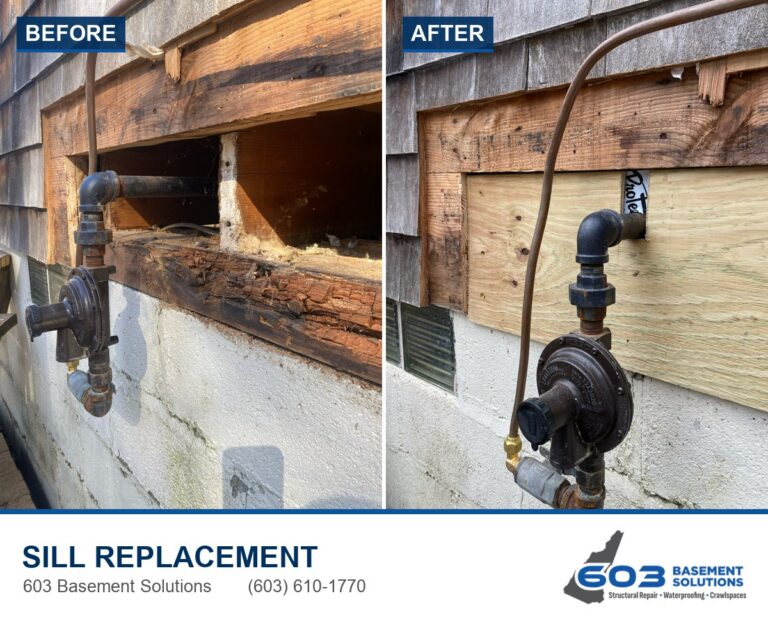
Confirmed sill-repair projects can range from $7,000 to $40,000 because a short accessible section is not the same job as damage extending around the house. A site inspection is the only responsible way to price it.
When the foundation itself needs work
We also inspect settling footings, inward-moving walls, and structural cracks. Helical piers may support settlement; carbon straps or steel braces may stabilize a wall. If the wall is stable and the issue is limited to one crack, foundation crack repair in Hudson may be all that is needed.
603 self-performs helical-pier installation and structural lifting. We do not offer mold remediation. If your concern falls outside our work, we would rather say that than squeeze it into the wrong scope.
If the outside footing is the part that settled, the repair may involve push piers or helical piers. Push piers use the existing building as reaction while sections are hydraulically advanced. Helical piers are rotated into the ground and checked through installation torque. We compare footing condition, building weight, equipment access, and the supported section before choosing. That underpinning decision does not replace inspection of the sill, beam, posts, and interior footings.
When the concrete, not the wood, is moving
A sloping floor can trace to a sill, beam, column, footing, or structural slab. We follow the load before choosing among them. For concrete, we look for displacement across a crack, ongoing change, and related movement in walls or openings. A stable mark in a basement floor may only need monitoring or a focused crack repair. A building-supporting slab that has moved may require stabilization or replacement. The slab foundation repair page covers that structural branch while the Hudson inspection separates it from wood and support work.
A useful proposal names the load and the repair
The written estimate should identify the failing component, repair location, quantity, access assumptions, and warranty. Lally-column work generally runs $1,300 to $2,500 and treated floor-support areas carry a 10-year warranty against further settlement. Other methods have their own coverage, which should be stated rather than implied.
The inspection and estimate are free, and 603 normally sends the written quote within 24 hours. We are licensed and insured and have worked in more than 5,000 homes.
Tell a sill, beam, and column scope apart
A sill repair treats the perimeter wood bearing on the foundation. A beam repair treats the member carrying joists across the basement or crawl space. A column repair restores support below that beam and must include a suitable base. These parts work together, but they are not substitutes.
If a proposal says “support work,” ask which member is damaged and which load is being transferred. The contractor should be able to show you the failed material or movement, identify the new support path, and explain what remains in place. That detail becomes especially important when finished ceilings or walls will hide the work later.
Stabilization and lifting have different goals
Stabilization is intended to stop further movement in the treated area. Lifting attempts to improve position and can affect flooring, partitions, cabinets, plumbing, and finishes above. The safest plan may not return every surface to perfect level. We explain the intended movement before work, and the proposal should state whether any lift is included.
Never turn an adjustable post yourself to chase a floor slope. Without measurements and a plan, that can move the load too quickly or push it into a weak beam, footing, or connection. Leave the post as found and tell us if anyone has adjusted it before.
Photographs that make the first visit better
Send one wide photograph showing the entire support area, one view along the beam, and a close image of the damaged wood or column base. Include a ruler or familiar object for scale where useful. If the symptom is upstairs, add a simple note showing which basement wall or beam sits below it.
Before the appointment, move storage without removing patches or temporary supports. Keep the route to the affected area clear. If a column, beam, or wall looks unsafe, do not touch it; keep the area empty and explain the condition when you call.
Hudson foundation questions
Can you tell from upstairs whether a beam or sill failed?
No. The pattern upstairs helps, but the framing and supports below need to be inspected.
Will a new lally column automatically level the floor?
No. Stabilizing and lifting are different goals. Any lift has to account for the structure, finishes, and utilities above.
Should I cover damaged sill material before the appointment?
Keep it accessible if it is safe to do so. Photographs showing the wider wall and nearby framing are useful.
Where can I review every repair method?
Find out what is carrying the floor and what is not
We will inspect the support path and give you a written answer.
Sources: U.S. Census Bureau, 2023 ACS 5-year table B25035; 603 confirmed service, pricing, warranty, and operating information. Work photography shows a 603 repair method.