
Quick Answer
Foundation repair by 603 Basement Solutions begins with measured conditions in Lexington, Massachusetts for footing movement, leaning walls, low floors, column failure, and sill or beam damage. The appropriate plan can involve piers, a wall system, support-column work, beam or sill replacement, narrow crack treatment, or documented monitoring. The next step is a free inspection followed by a written estimate.
A home-inspection note is the start of the conversation
“Foundation concern” can mean a hairline mark, active settlement, a bowing wall, a weak sill, or a floor support that was never set correctly. Those are not interchangeable repairs. If a report sent you here, show us the exact note and the photos that came with it. We will connect that observation to the structure around it.
We measure before we recommend. That means checking the wall in more than one place, looking at the framing above, and tracing loads toward the footing. Sometimes the right move is to document the condition and watch it. We care more about the right answer than selling a system the house does not need.
Lexington homes do not fit one age-based template
Lexington’s median housing year is 1964 in the 2023 American Community Survey. It is a citywide midpoint, not a description of your basement. A house may have an older core, a newer addition, replaced framing, or repairs from several owners. We inspect those transitions because movement often shows up where materials or loads change.

Foundation Problems, Inspection Points, and Possible Repairs in Lexington
| What you are seeing | What 603 inspects | Possible repair |
|---|---|---|
| One wall line no longer matches earlier elevations | Review level readings, footing condition, structural loads, and site access | Monitoring remains an option when current movement is not established |
| One foundation wall has changed shape under outside pressure | Document deflection while reviewing masonry condition and water management | Wall reinforcement can be selected for the material and displacement found |
| A floor sags near a beam or interior post | Define damaged material and identify what must be held during repair | Unsound structural wood can be replaced in a planned support sequence |
| A slab has changed elevation near another structural element | Record direction, width, displacement, moisture, and changes around it | Slab repair depends on whether the changed concrete is structural |
The possible-repair column does not prescribe work for a Lexington property.
Typical Foundation Repair Pricing
One method has current published pricing. The current rate for helical piers beneath an existing foundation is $2,700 per pier through the first three, then $2,200 per pier. Massachusetts structural piering projects typically run $12,000 to $18,000 or more.
Other methods depend on wall length, access, materials, support layout, and the intended result. See the helical pier cost guide for worked pier-count examples; the free Lexington inspection supplies the actual written scope.
Map the symptom through the house
One clue rarely gives a complete answer. A diagonal drywall crack becomes more useful when it lines up with a low floor and a changed door below. A basement crack means more when its width, direction, and displacement can be compared with the wall around it. We ask what appeared first, what has changed, and what stayed the same.
Settlement has to be supported at the source
When a footing or outside corner is dropping, patching the crack above it does not support the load. Helical piers may be used to transfer that load to competent bearing material. The layout is based on the structure and access, not a standard package. We inspect exterior clearance, utilities, the foundation connection, and the framing that will be affected before defining the pier plan.
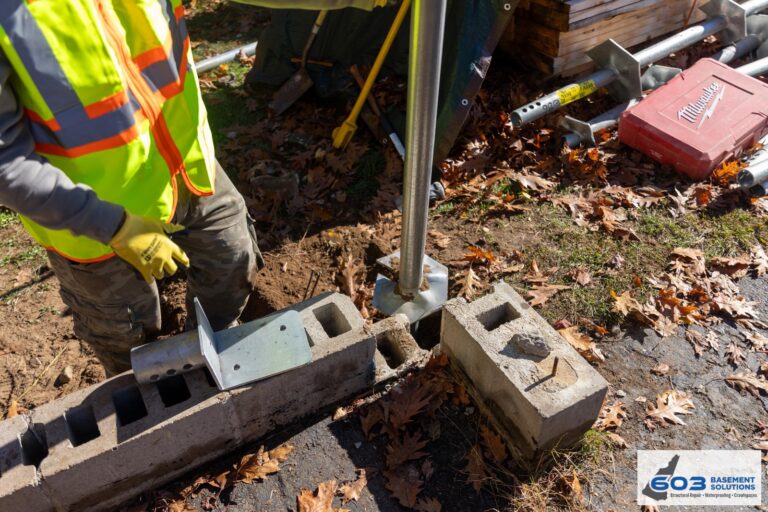
Ask a pier contractor what the proposal is designed to do. Stopping further settlement and attempting lift are different goals. The estimate should name the number of piers, their locations, bracket details, access assumptions, restoration exclusions, and the warranty tied to the proposed system.
Wall movement calls for a different set of measurements
A horizontal crack or inward curve is checked from the ends of the wall toward the middle. We also look for stair-step cracking, displaced block, framing pressure, and anything that interferes with brace or strap placement. Steel braces and carbon-fiber straps can both stabilize walls, but they fit different conditions. A product should follow the measurement.
603’s confirmed price is $1,300 per installed steel brace and $850 per carbon-fiber strap. Treated wall stabilization carries a 25-year warranty against further inward movement within the stated design tolerances. Your written scope determines which method and quantity apply to your wall.
Crack repair stays separate when the wall is stable
A stable poured-concrete crack that leaks may need injection rather than a broad structural repair. Structural epoxy and polyurethane solve different problems, and neither one braces a moving wall or supports a sinking footing. Our Lexington foundation crack repair page covers that smaller decision.
Keeping the scopes separate matters when you compare estimates. One contractor may price a seal. Another may price the movement that opened the crack. Ask each one to point to the evidence behind the recommendation.
What the 603 visit gives you
A plain diagnosis
We show you which parts are sound, which parts changed, and why that matters.
A defined repair
Quantities, locations, method, and access belong in the written quote.
A no-repair answer
If monitoring is reasonable, we tell you what to photograph and what change should trigger another look.
A sequence
If other renovation work is planned, we explain what should happen before walls, floors, or utilities cover the area.
The inspection and estimate are free, and 603 normally sends the quote within 24 hours. We are licensed and insured and have worked in more than 5,000 homes across New Hampshire, southern Maine, and northeastern Massachusetts.
Make monitoring specific enough to mean something
Monitoring is not ignoring the condition. Pick fixed points and a schedule. Place a ruler beside the crack, take a wide photo that shows its location, and repeat both images from the same angle. For a floor, record the same points along the same line. For a wall, do not rely on a single pencil mark that can smudge or disappear behind storage.
Write down related changes separately. A door that sticks only during humid weather is different evidence from a new gap that remains through several seasons. Note renovations, heavy furniture, plumbing leaks, exterior work, and any adjustment made to a post. That timeline helps the next measurement make sense.
The inspection should tell you what change ends the monitoring period. That might be measurable growth, new displacement, a second connected symptom, moisture, or a support that no longer bears correctly. Without a trigger, “watch it” can turn into years of uncertainty.
If the condition changes, bring the full photo set back. We can compare the same references instead of starting over. If it stays stable, you have evidence that supports the smaller decision and helps prevent an unnecessary structural sale.
Read the final Lexington proposal aloud
You should be able to describe the work without contractor shorthand. Name the weak component, the repair method, every location, the intended outcome, and anything that must move first. If the quote says “foundation system” but never tells you whether it braces a wall, supports a footing, or carries a beam, it is not ready.
Check the exclusions next. Engineering, permits, utility relocation, demolition, disposal, landscaping, and finish restoration can change the total project. Then check the warranty against the promised outcome. A stabilization warranty is not a promise to make an old floor perfectly level.
Finally, compare the diagnosis across bidders. If one company saw wall pressure and another saw settlement, ask them to show the measurements. The cheapest answer to the wrong problem is still expensive.
Questions Lexington homeowners ask
Does a sticking door prove the foundation moved?
No. Humidity, hinges, and framing can affect a door. It becomes stronger evidence when the change is new and lines up with movement elsewhere.
Can I renovate while I monitor a crack?
Keep the area accessible until the monitoring period is complete. Covering the wall or changing the floor can erase the reference points you need.
Who installs 603’s structural systems?
Our own crew performs structural lifting and helical-pier installation. The proposal should still explain any engineering, permit, or restoration work outside the installation scope.
Where do I compare foundation repair costs?
Use our foundation repair cost guide for verified ranges, then rely on the house-specific inspection for the final quantity and method.
For the full repair menu, visit Structural and Foundation Repair.
Before the Lexington appointment
Leave cracks, posts, and patches visible. Move storage only when it is safe, and do not adjust a support or remove finish material on speculation. Collect the home inspector’s wording, renovation drawings, and any photograph that predates the change.
Tell us what outcome matters most: stopping new movement, understanding a report, planning a renovation, or correcting a known support. That helps us explain the choices without pretending every old condition needs the largest repair.
Why Homeowners Choose 603 for Foundation Repair
Before choosing a repair company in Lexington, use the real customer and work evidence below alongside the diagnosis and price.
Start with measurements, not a guess
Book a free Lexington inspection. We will show you where the movement starts and which repair, if any, fits.
Sources: U.S. Census Bureau, 2023 ACS 5-year table B25035; 603 confirmed service, pricing, warranty, and operating information. Work photography shows a 603 repair method.