
Quick Answer
For structural foundation concerns, 603 Basement Solutions serves homeowners in Stow, Massachusetts for settlement, inward wall movement, uneven floors, failed columns, and damaged sills or beams. Possible scopes include deep foundation support, wall bracing, beam or post correction, sill work, focused crack repair, or no major work yet. The inspection and written repair proposal are provided without charge.
Measure the floor before anyone turns an adjustable post
An adjustable post can move a floor fast. It can also move doors, tile, cabinets, trim, and plumbing before anyone has written a stopping point.
We record the starting floor and the complete support path first. Adjustment happens only when the scope names the target, checkpoints, and limits.
What Stow’s townwide housing number can tell us
The 2023 American Community Survey places Stow’s median housing year at 1973. It cannot tell us whether one post is original, added later, or bearing correctly.
Bring earlier inspection reports and photographs when they show the same beam or floor. Keep homeowner observations separate from assumptions about cause.

Foundation Problems, Inspection Points, and Possible Repairs in Stow
| What you are seeing | What 603 inspects | Possible repair |
|---|---|---|
| A chimney or supported projection is pulling from the house | Map connected symptoms before checking bearing below the affected zone | Helical or push piers may be designed where competent bearing is needed |
| A stair-step pattern appears with wall displacement | Measure displacement and assess material, drainage, soil pressure, and loads | Repair may focus on restraint, drainage, rebuilding, or a combination |
| A floor sags near a beam or interior post | Check the whole support line instead of judging one shiny or temporary post | Column, beam, sill, or footing work may restore the support path |
| A crack is visible without obvious movement elsewhere | Separate water entry from movement by checking the wall and connected loads | The crack should be routed to its own repair only after diagnosis |
The possible-repair column does not prescribe work for a Stow property.
Typical Foundation Repair Pricing
For helical-pier foundation work, 603 publishes its present rate. Three existing-foundation helical piers price at $2,700 each under 603’s current schedule. The rate becomes $2,200 for each additional pier; typical Massachusetts structural piering is $12,000 to $18,000 or more.
A city page cannot substitute for measurements, quantities, access, and a defined outcome. See the helical pier cost guide for worked pier-count examples; the free Stow inspection supplies the actual written scope.
Start with what you can see
A post has a threaded top
Do not turn it before mapping the beam and starting elevations.
A door rubs upstairs
Record it as an adjustment checkpoint, not proof of the cause.
Tile crosses the low area
Put cracking risk and stop rules into the written plan.
The floor feels firm but slopes
Separate current support from a promise to level an older condition.
Create the elevation baseline
Choose fixed points across the room and stable controls outside the affected zone. Record the tool, surface, units, direction, and date.
Mark doors, trim, tile, cabinets, plumbing, and other finishes that can respond during movement. Photograph them before work.
Inspect every support before choosing adjustment
Trace joists into the beam. Check beam damage, splices, top connections, posts, bases, slab, and footing evidence.
A low point does not tell us which component is weak. The load path does.
Use checkpoints instead of hope
Write the intended result and maximum adjustment before work. Pause at small intervals to repeat floor and finish checks.
Stop at the agreed condition even if the floor remains imperfect. The final Stow notes should record the supported position.
Do not give the post one more turn
An adjustable post can move a floor before you have time to see what else is moving with it. Leave the nut and shims where they are. Note doors that rub, tile near the low area, cabinet gaps, plumbing above, and whether the floor feels firm or bouncy.
Those details become checkpoints if adjustment is considered. A post can add support without safely making an older floor flat, so we treat support and leveling as two separate decisions.
A threaded post does not tell you whether it is temporary
We cannot judge a support by its screw top alone. The beam connection, post condition, base, bearing, and load above all matter. Some adjustable columns are part of a lasting system; others were placed without adequate connections or footing support.
A low reading directly above the post also does not prove the post caused it. We extend measurements to the next supports and into a stable part of the room before choosing the work area.
What we record before moving a Stow floor
We set repeatable floor points and note the exact surface used for each reading. Then we trace joists to the beam and inspect its ends, splices, posts, bases, and visible bearing. Doors, trim, tile, cabinets, and plumbing are checked before any load changes.
If adjustment is proposed, the estimate should name the intended result and the condition that stops movement. We pause at small steps rather than chasing a perfectly level number while finishes object.
When monitoring is the honest answer
Another set of measurements may be the only sensible next step when the beam is supported and the post is secure. The old slope also needs to be stable. We can leave you with points that are easy to find again.
Call sooner if the post leans, the top separates from the beam, the base shifts, or doors and tile change quickly. Do not place another jack beside it; that creates a new load condition before the original one is understood.
Freeze the Stow starting point
Do not turn the post, tap shims, or place a jack nearby. Put a small piece of tape beside the post instead, and note which door, tile line, cabinet, or plumbing fixture sits above the low area.
Walk into a part of the room that feels normal so we have a stable comparison. A floor map needs both the concern and an unaffected point; otherwise one low reading has no useful context.
If someone adjusted the post before, write down roughly when and what changed afterward. Memory is not a measurement, but it helps us decide which finishes deserve special attention if movement is proposed again.
A good recommendation may be to support the floor and leave its familiar slope alone. That is not an incomplete repair. It is a deliberate choice to protect the load path without forcing movement into doors, tile, cabinets, or plumbing that are working now.
If you have a long level, leave it where it is. We bring measurement tools and use fixed surfaces that can be found again. A bubble centered on one board cannot tell us how the room, beam, and supports relate. The useful pattern comes from several points, recorded in order, including an area outside the concern. That pattern also gives us a safe way to stop if adjustment is attempted.
Measure the Stow slab before changing a support
An adjustable post can sit on a separate footing, on an ordinary basement floor, or over a slab that supports the building. The inspection identifies that bearing before anyone changes the post. In Stow, concrete displacement and a line that continues to change matter. Matching movement at the supported beam adds stronger context than one threaded top. The evidence may point to monitoring, focused crack repair, stabilization, or replacement. It may also leave the slab outside the repair. See slab foundation repair for the approach used when the load-carrying concrete, rather than post adjustment alone, is part of the finding.
If the floor or beam needs support
We follow the Stow floor load through joists and beam to the post base and bearing below. A new column is useful only when it sits under the load that needs help. 603 lally columns usually cost $1,300 to $2,500 each, and the treated support area has a 10-year settlement warranty.
If the wall is moving inward
We measure the full wall before choosing braces or straps. Power braces cost $1,300 each and carbon-fiber straps cost $850 through 603. The treated wall carries a 25-year warranty within the stated limits. A stable leaking crack may need a smaller crack-repair scope instead.
If the footing section needs support
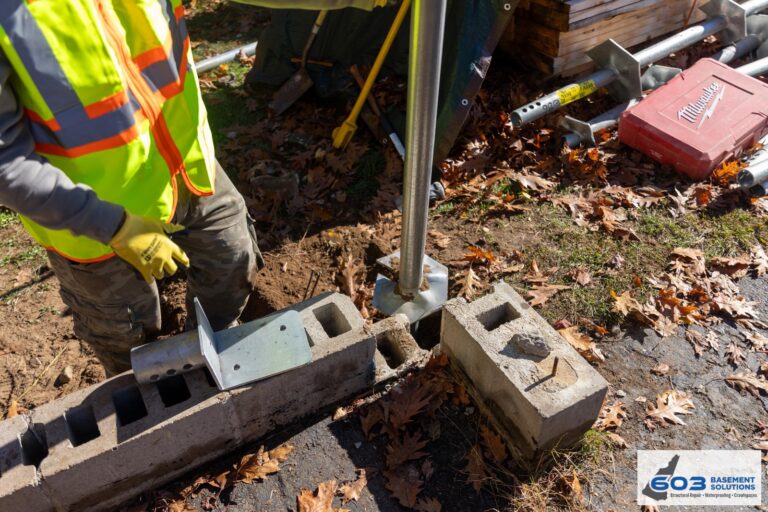
How pier selection fits this finding. Turning a Stow post does not establish that the exterior footing has settled. If a measured footing section does need support, push piers use the existing structure as reaction during installation and helical piers advance with helical plates. The available house weight, footing condition, access, and repair design determine the choice. Starting floor readings and stop limits must be recorded before either system or any adjustment is proposed.
Before your Stow inspection
- Freeze the Stow baseline. Leave posts and shims exactly as found.
- Map rooms to supports. Connect every elevation point with the beam below.
- Set adjustment pauses. Name the reading and finish condition that stops work.
- Keep final points. Use the same references for later monitoring.
Stow foundation questions
Can I turn an adjustable post myself?
Do not change a loaded support without a measured plan.
Will support make an old floor flat?
Not always. Support and adjustment are different outcomes.
Why record doors and tile?
They can react while the structure is adjusted.
Does monitoring mean no repair is needed?
It means another dated reading can answer whether the condition is changing.
What 603 documents during a Stow structural inspection
The decision begins with this page’s central issue: Measure the floor before anyone turns an adjustable post. The crew maps that observation to the connected wall, footing, beam, post, or floor before a repair enters the proposal.
603 is licensed and insured and has worked in more than 5,000 homes. Its own crews install helical piers and perform structural lifting. The inspection and estimate cost nothing; the written quote normally follows within 24 hours and identifies the treated area, quantities, intended result, exclusions, and warranty.
Why Homeowners Choose 603 for Foundation Repair
603’s customer feedback and field documentation below give Stow owners concrete evidence to weigh with the written scope.
Get the Stow load path checked
Your Stow visit will connect the measurements to a defined repair boundary and a written scope that can be checked against the house.
Sources: U.S. Census Bureau, 2023 ACS 5-year table B25035. The city image caption links its Wikimedia Commons source and license. 603 supplied the confirmed service, pricing, warranty, and operating information. Work imagery shows a 603 repair method. See Structural and Foundation Repair or the Foundation Crack Repair service.