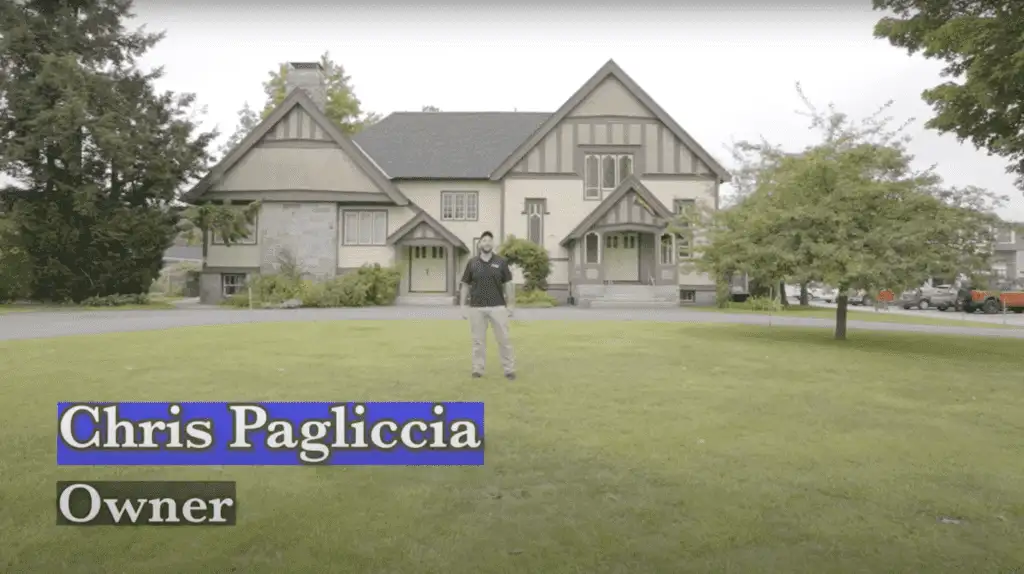

By Chris Pagliccia, 603 Basement Solutions
Quick answer: An old house isn’t safer from radon than a new one, and a house with no basement isn’t off the hook either. Radon is a soil gas. It rises up out of the ground under your home and settles into the lowest level, in homes of any age, with or without a basement [MA DPH]. A 1780 farmhouse and a brand-new build sitting on the same granite can both read high. Your radon comes down to the rock under the slab [USGS]. The age of the framing above it barely matters.
“Too old, too drafty, no basement” is a myth, and it runs backwards
All three versions of that line are wrong, and for the same reason: radon comes from the ground under the house, not from the house. We hear it all the time. “My place is 200 years old, it breathes, there’s no way it’s got radon.” Or “I’m on a slab, no basement, so I’m fine.” A tight new build and a drafty old farmhouse both sit on the same dirt, and that dirt is where the gas is made [MA DPH]. Age doesn’t shield you. If anything, an old New England house can read higher than the new one next door, and we’ll get to why.
Where does radon actually get into an old house?
It gets in wherever the ground touches your indoor air. In a normal basement that’s the floor wall joint (the seam where the slab meets the wall), cracks in the slab, the open sump pit, and the gaps around every pipe and penetration that passes through the floor [MA DPH]. Radon’s a gas. It follows the path of least resistance and drifts up into the rooms above.
Old New England homes give it more ways in than that. In the fieldstone basements we open up, the floor is often bare dirt, or a thin rough slab somebody poured over dirt decades ago. The walls are stacked stone with the mortar crumbling out from between the rocks. That’s not one crack to seal. That’s a whole wall of gaps, top to bottom, and a stone-and-mortar foundation has hundreds of them. Stand in one of those cellars on a still day and you can smell the ground and feel the damp coming up off the bare dirt. That’s the soil talking to your house.
Dirt-floor crawl spaces are the same story, only tighter and worse. There’s nothing between the soil and your living space but a couple feet of open air, and whatever comes up out of that dirt ends up in the rooms overhead. And a house on a slab with no basement? That slab still sits right on the ground, with its own joints and penetrations [MA DPH]. No basement doesn’t mean no radon. It just means the lowest level is where you live.
Why the age of the house doesn’t matter
Because the gas is made in the bedrock under the slab, not in the building on top of it. Radon is a decay product of uranium-238, and northern New England sits on rock that’s naturally loaded with it [USGS]. In New Hampshire that’s the Conway Granite and the White Mountain plutons. Over in Maine it’s the Sebago granite. That ledge was here long before anyone framed a cape on top of it, and it’ll be giving off radon long after. The gas works its way up out of the ground into the lowest level of whatever’s built there [MA DPH].
So the year on the deed barely enters into it. A 250-year-old antique cape and a new build going up next door can pull from the same granite and both come back high. It’s why radon turns up all over the map here, not in one kind of house. Readings over 100 pCi/L, twenty-five times the EPA’s action level, have been reported in every single county in New Hampshire, old housing stock and new alike [NH DHHS 2023]. Every county we work runs high, Rockingham and Strafford here in New Hampshire, York County right across the line in Maine. The full county-by-county numbers are in our tri-state radon data guide.
The fieldstone and dirt-floor crawl-space wrinkle
Old porous foundations can let more radon in, not less, and how you seal them up changes the airflow under the house. A crumbling fieldstone wall and a dirt crawl-space floor hand radon a bigger, easier path than a poured concrete basement does, because there’s so much more open ground and open seam for the gas to move through. That’s the wrinkle with a lot of antique New England homes. The stone cellar, the dirt floor, the low crawl, the very things that make the place charming are the same things that give radon an easy way in.
Sealing those spaces changes the picture, and it cuts both ways. When you encapsulate a crawl space or cap a dirt floor, you’re changing how air and soil gas move underneath, which is exactly why the sealing and the radon system get planned together, not one after the other. We won’t re-explain all of that here. Two pages cover it:
- How sealing a dirt crawl handles moisture and radon at the same time: crawl space encapsulation.
- How a basement gets waterproofed and set up with a radon system so the two work as one: waterproofing with a radon mitigation system.
There’s no safe town, even a “low” one
Even the lowest-average county around here still turns up plenty of high homes. The EPA is blunt about it: there’s no safe level of radon [EPA]. And “low average” isn’t the same as low. Take Sullivan County, the lowest-average county in New Hampshire. Even there, roughly one test in eight came back over the action level [NH EPHT 2016]. A low county average is cold comfort. It tells you the odds across a lot of houses. It tells you nothing about the one you’re standing in.
For your bearings: the EPA’s action level is 4.0 pCi/L, and they say to consider fixing anywhere from 2 to 4 [EPA]. The average American home runs about 1.3 pCi/L indoors, and outdoor air sits near 0.4 [EPA]. An old farmhouse on granite can run many times higher than that, and you would never know by living in it. You can’t see radon, smell it, or taste it.
What to do: test, no matter how old the house is
Test the air. That’s the whole move, and it’s the same move whether the house went up in 1790 or last spring [EPA]. A short-term test tells you fast if you’ve got a problem, and a longer or follow-up test confirms it. You don’t have to guess from the age of the house or the look of the foundation. A test in your own basement settles it.
Where to take it from here:
- Ready to test, or want to confirm a reading you already have: radon testing.
- The county-by-county data behind all of this: our tri-state radon data guide.
- On a private well? Radon in water is a separate map with its own rules: radon in New England well water.
- The specific questions (“is 3.0 something to worry about?”, “does it change from summer to winter?”): our radon answers hub.
One straight note on us. 603 is certified for radon measurement and testing (NRSB RMS-113966), so figuring out what’s in your air is squarely our lane. We’re finishing a separate report on what we’ve actually measured in old Seacoast basements, and we’ll link it right here once it’s ready.
Talk to a real person about your old house
Got an antique cape, a fieldstone cellar, or a dirt crawl and no idea what’s coming up out of the ground? That’s the normal place to start, and it’s an easy thing to settle. Call 603-610-1770 and talk to Chris or one of the crew about getting the air tested. No pressure, no script. Or book your free inspection and we’ll come take a look. We’re right here on the Seacoast, and we cover New Hampshire, Maine, and Massachusetts.
Sources
Every fact on this page traces to public agency data, reused from our tri-state radon pillar. The hands-on read of old fieldstone basements and dirt crawl spaces is our crew’s own field experience, offered as experience, not as a measured statistic.
- [EPA]: U.S. EPA, “A Citizen’s Guide to Radon” and “Health Risk of Radon.” Radon is a decay product with no safe level; EPA action level 4.0 pCi/L, consider fixing 2 to 4; U.S. indoor average about 1.3 pCi/L, outdoor air about 0.4. https://www.epa.gov/radon/health-risk-radon
- [MA DPH]: Mass.gov / Massachusetts DPH, “Radon – get the facts.” Radon is a soil gas that enters through floor wall joints, cracks, sump openings, and slab penetrations, collects in the lowest level of the home, and is found in homes of any age, with or without a basement. https://www.mass.gov/info-details/radon-get-the-facts
- [USGS]: U.S. Geological Survey, New England Water Science Center. Radon is a decay product of uranium-238; northern New England bedrock is naturally high in it, including the Conway Granite and White Mountain plutons in New Hampshire and the Sebago granite in Maine. https://www.usgs.gov/centers/new-england-water-science-center/news/new-maps-predict-areas-elevated-radon-uranium-new
- [NH DHHS 2023]: NH DHHS, “Radon Risk in New Hampshire” data brief, Aug 2023 (test results 2007-2021, n=32,747, self-selected). Readings over 100 pCi/L, about 25 times the action level, have been reported in every NH county. https://www.dhhs.nh.gov/sites/g/files/ehbemt476/files/documents2/radon-data-brief-final.pdf
- [NH EPHT 2016]: NH DHHS EPHT, “Spotlight: Radon Risk,” Jan 2016 (test results 1988-2011, n=25,476). Sullivan County, the lowest-average county in New Hampshire, still had roughly 1 in 8 tests (about 12%) over the 4.0 action level. http://tinymce.nhwis.net/plugins/moxiemanager/data/files/docs/Radon_Jan2016_Final.pdf
The rest of our research is on the basement and radon research page.