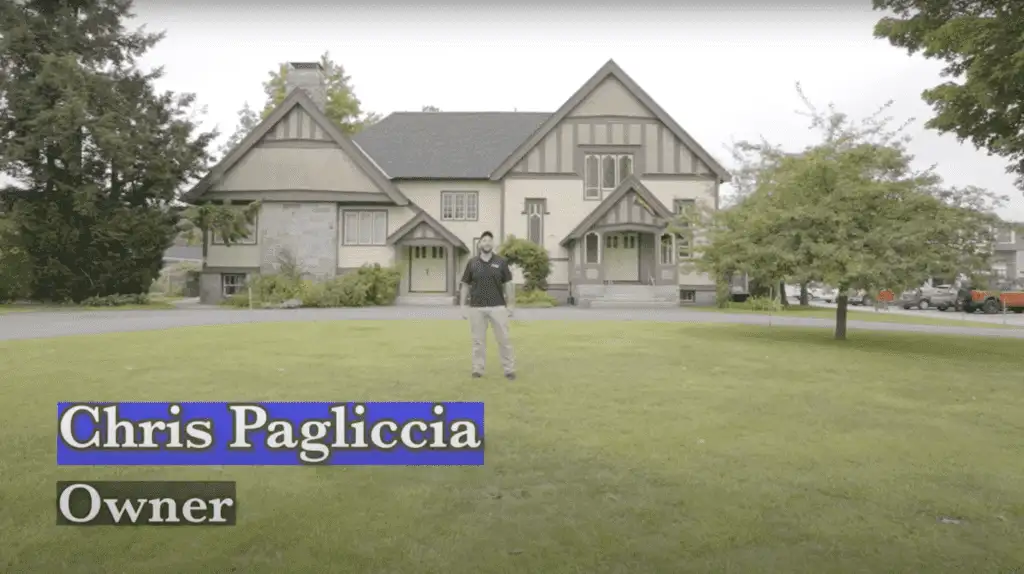

By Chris Pagliccia, 603 Basement Solutions
Quick answer: Air radon and water radon are two different problems on two different scales. The radon coming up through your slab has one number that matters, the EPA action level of 4.0 pCi/L [EPA]. Radon in well water gets measured in the thousands, and every New England state drew its own advisory line [Maine CDC MEG]. The two don’t sit on the same map. A Seacoast home can read high in the air and have zero water problem, and a White Mountains well can carry very high water radon where the air map looks quiet [NH DHHS 2023; USGS]. So the order is simple. Test your air first. Chase the water only if you’re on a private well.
This page is the water side, and how it does and doesn’t connect to the air. For the county-by-county air numbers across all three states, that’s our tri-state radon data guide.
Air radon and water radon are two different maps
They come from the same element but reach you two different ways, and they don’t line up on the map. Soil-gas radon seeps up out of the bedrock into the lowest level of your house. That’s the one the EPA flags at 4.0 pCi/L [EPA]. Waterborne radon rides in dissolved in your well water and comes out when you use it. Different path, different scale, different fix.
The two maps don’t match, and that’s what trips people up. In New Hampshire the worst indoor-AIR radon sits down in the southeast, the Seacoast and the eastern belt, your Rockingham and Strafford County towns [NH DHHS 2023]. But the USGS puts the highest groundwater radon probability up north, in the White Mountains and north-central New Hampshire, and figures about 55% of the state is more likely than not to have elevated radon in its groundwater [USGS]. Same state, two different hot zones. You can’t read one off the other.
How water radon gets into your air (the ~10,000-to-1 rule)
Most of the health risk from water radon happens in the air, not the glass. The radon comes out of the water when you use it, and you breathe it in. Drinking it is the smaller risk. The National Academy of Sciences put the transfer at roughly 10,000 to 1: about 10,000 pCi/L of radon in your water adds about 1 pCi/L to the air inside your house [Maine CDC MEG, citing NAS]. Run that backward and a well testing 20,000 pCi/L is putting about 2 pCi/L into your indoor air, on top of whatever’s already coming up through the slab.
It comes out of the water when you agitate it. Showering, running the dishwasher, doing laundry, filling the sink. That’s why water radon shows up as an air problem in the bathroom and the kitchen. So does well water cause radon in the air? Yes, it can add to it, but only when the water number is way up in the thousands.
What counts as “high” radon in well water, state by state
There’s no single national line for radon in drinking water. The EPA never finalized an enforceable federal standard for it, and it doesn’t regulate private wells at all [Maine CDC MEG]. So each New England state set its own advisory flag, and they land all over the place:
| State | Well-water advisory level | Note |
|---|---|---|
| New Hampshire | 2,000 pCi/L | [Maine CDC MEG] |
| Maine | 4,000 pCi/L | lowered from 20,000 in 2006 [Maine CDC MEG] |
| Massachusetts | 10,000 pCi/L | [Maine CDC MEG] |
| Connecticut | 5,000 pCi/L | [Maine CDC MEG] |
| Rhode Island | 4,000 pCi/L | [Maine CDC MEG] |
Read that table and you’d think radon is five times more dangerous in a New Hampshire well than a Massachusetts one. It isn’t. These are risk-management calls. The science underneath is the same in every state, and each one drew its line in a different place. Maine says it plainly in its own history: it used to flag at 20,000 and dropped that to 4,000 in 2006 [Maine CDC MEG]. The radon didn’t change. The judgment did. And none of these are enforceable rules on a private well. They’re advisories. On your own well, testing and treating is on you.
Notice the scale, too. Your air action level is 4.0. These water flags are in the thousands. That’s the 10,000-to-1 rule doing its work. It takes a lot of radon in water to move the air number even a little.
Where the water problem actually is (and where the air problem is)
The water hot spots and the air hot spots sit in different parts of the map, and it’s the rock that decides. Radon is a decay product of uranium-238, and northern New England sits on bedrock that’s loaded with it [USGS]. In New Hampshire that’s the Conway Granite and the White Mountain plutons. In Maine it’s the Sebago granite of the southwest. The same granite that pushes radon up through your slab also loads up the groundwater running through it.
So the WATER problem runs north and inland: the White Mountains and north-central New Hampshire, and the granite country of southwestern Maine [USGS]. The USGS estimates something like 324,000 rural Mainers are on wells at risk of topping 4,000 pCi/L [USGS]. The AIR problem is somewhere else. New Hampshire’s worst indoor-air testing is down on the Seacoast and the eastern side, Rockingham and Strafford [NH DHHS 2023].
Plenty of the Seacoast homes we open up are on town water, so their high air reading had nothing to do with a well. Two different problems. Don’t let a high air test send you chasing a water fix you may not need, and don’t read a quiet air test as proof your well is clean.
On a private well? Test the air first, then the water
If you’re on a private well, the testing is yours, because nobody’s doing it for you. Roughly 44% of New Hampshire households are on a private well [CDC NH], and the CDC figures about half of New Hampshire’s bedrock wells carry radon worth worrying about [CDC NH]. Maine leans on wells even harder, about half its residents [Maine CDC]. Massachusetts is the other way around, overwhelmingly on public water, with only something like 7 to 10% of homes on private wells [MA]. A public system already tests and treats for radon. Your well doesn’t get that.
Order matters, and it’s the same order every state recommends. Test the air first with a radon test. That one test tells you whether you’ve got a radon problem at all, from any source. If the air comes back high, or you’re on a private well, then test the water too. Air first, water second. Not the other way around.
Simple reason. In most New England basements the radon is coming up through the slab, and the air test catches that. The water test only tells you whether your well is piling more on top. If you’re in an older house on a well, the same private-well, old-home crowd, our radon in old New England homes page walks through why the age of the house barely matters and the rock does.
What to do with a high water number
Start with the air, then treat the water at the point it comes into the house. New Hampshire flags well water at 2,000 pCi/L [Maine CDC MEG]. So the water number rarely stands alone. You read it next to your air number, and if the air is over the 4.0 action level and the well is running high, that’s when treating the water comes into the conversation.
Treating radon in water is a water-treatment job, done where the well line enters the house, usually by venting it out of the water or running it through a carbon filter. That’s a different trade from ours. 603 is certified for radon measurement and testing (NRSB RMS-113966), so we can test your air and point you the right way on the water. We won’t sell you a water system we don’t install.
Where to go from here:
- Get the air tested first: radon testing.
- See your county’s air numbers: our tri-state radon data guide.
- The specific questions (is 3.0 concerning, does it change at resale): our radon answers hub.
- What a mitigation system runs: our radon mitigation cost guide.
For the Seacoast readings we’ve taken ourselves, those live in a separate report we’re finishing now, and we’ll link it here once it’s out.
One more thing on the health, in the EPA’s words and not ours: there’s no safe level of radon, it’s the second leading cause of lung cancer and the top cause among people who never smoked, and the EPA ties about 21,000 lung-cancer deaths a year to it [EPA]. You can’t see it, smell it, or taste it. But you can measure it. That’s the whole point of a test.
Talk to a real person about your well
Got a water or air number in hand and you’re not sure what it means? Call 603-610-1770 and talk to Chris or one of the crew. We’ll tell you straight whether it’s the air, the water, or nothing to lose sleep over. Or book your free inspection and we’ll come test the air. We cover New Hampshire, Maine, and Massachusetts, home base right here on the Seacoast.
Sources
- [EPA]: U.S. EPA, “A Citizen’s Guide to Radon” and “Health Risk of Radon.” Air action level 4.0 pCi/L, consider fixing 2 to 4, no safe level; second leading cause of lung cancer and number one among never-smokers; ~21,000 U.S. deaths/yr. https://www.epa.gov/radon/health-risk-radon
- [Maine CDC MEG]: Maine CDC, “Maximum Exposure Guideline for Radon in Drinking Water,” Oct 2006. New England well-water advisories (NH 2,000 / ME 4,000, lowered from 20,000 in 2006 / MA 10,000 / CT 5,000 / RI 4,000 pCi/L); ~10,000:1 water-to-air transfer ratio (per NAS); no finalized federal enforceable water-radon standard; EPA does not regulate private wells. https://www.maine.gov/dhhs/mecdc/sites/maine.gov.dhhs.mecdc/files/MEG%20analysis%20paper.pdf
- [NH DHHS 2023]: NH DHHS, “Radon Risk in New Hampshire” data brief, Aug 2023. Indoor-air radon highest in the southeast / Seacoast / eastern belt; Rockingham and Strafford among the worst counties. https://www.dhhs.nh.gov/sites/g/files/ehbemt476/files/documents2/radon-data-brief-final.pdf
- [USGS]: USGS New England Water Science Center (Dec 2022 NH groundwater maps) and Yang et al. 2014 (Maine well water). ~55% of NH more-likely-than-not to have elevated groundwater radon, highest in the White Mountains / north-central NH; ~324,000 rural Mainers on wells at risk of exceeding 4,000 pCi/L; geology: uranium-238 in the Conway Granite / White Mountain plutons (NH) and Sebago granite (ME). https://www.usgs.gov/centers/new-england-water-science-center/news/new-maps-predict-areas-elevated-radon-uranium-new
- [CDC NH]: CDC New Hampshire Environmental Public Health Tracking. ~44% of NH households on private wells; ~half of NH bedrock wells have radon of concern. https://www.cdc.gov/environmental-health-tracking/php/our-work/about-new-hampshire-tracking.html
- [Maine CDC]: Maine Tracking Network (Maine CDC), radon topic. About half of Maine residents rely on private wells, the highest share of the three states. https://data.mainepublichealth.gov/tracking/radon
- [MA]: Massachusetts is overwhelmingly on public water (~90 to 93%), leaving roughly 7 to 10% of homes on private wells (comparative figure from the Maine CDC / Maine Tracking Network private-well analysis). https://data.mainepublichealth.gov/tracking/radon
The rest of our research is on the basement and radon research page.