

Exeter crawl-space encapsulation works when drainage, damaged framing, liner details, and dehumidification are put in the right order. 603 enters the crawl and writes that order down. Most scopes fall from $3,000 to $25,000.
Inspect the wood before covering the ground
Encapsulation is moisture control, not camouflage. In an Exeter crawl, we first look at joist ends, sill, beams, posts, and the area around plumbing penetrations. If wood has softened or a floor has begun to move, that work is identified before a liner changes the view.
A clean, white crawl can still have a weak load path above it. The sequence matters: repair what carries the house, address water that enters, then create the sealed moisture boundary.
Follow water downhill
Standing water and humid soil are related but different conditions. A puddle after storms needs a collection and discharge plan. Constant ground vapor needs a continuous liner and controlled air. We look for stains, silt, low points, pump history, and the exterior endpoint before choosing equipment.
Where drainage is required, it is installed before the final liner so the systems connect cleanly. Where it is not, we do not add a pump just to make the proposal look more complete.
Seal the complicated edges
The hard part is rarely the open center. Columns, stone or irregular walls, pipe clusters, steps, and a low hatch create the weak points. Materials must be cut, lapped, and sealed around each one without making future service impossible.
Wall barrier and floor liner meet as one boundary. Vents are closed as part of the system. The dehumidifier then controls the air inside that boundary instead of trying to condition the outdoors.
Price reflects labor below the floor
Encapsulation runs from $3,000 to $25,000. Two equal-size crawls can price differently when one is clear and tall while the other requires debris removal, hand carrying, drainage, or framing repair. We enter the space before assigning a number.
The written warranty covers the liner, wall barriers, and workmanship for 25 years. Equipment follows its own terms. Damage caused later by another trade cutting the barrier is not the same as a failed seam.
Leave us the useful clues
- Note the rooms where odor or cold floors are strongest.
- Tell us when the crawl last held standing water.
- Identify old pumps, drains, vents, and inaccessible sections.
- Keep photos from plumbing leaks separate from rain-related moisture.
What a customer said about this kind of work
Encapsulation and insulation are not synonyms
The liner controls ground moisture and air exchange. Insulation addresses heat flow. Existing fiberglass may be damp, falling, or hiding wood that needs inspection. We decide what should be removed and where insulation belongs after the crawl boundary is defined.
That sequence matters around ducts and pipes. Condensation can improve when humid outdoor air is excluded, but cold surfaces and plumbing still need proper treatment. The proposal should name moisture control and insulation separately so you know which problem each line is intended to solve.
How a 603 project moves from question to closeout
1. Establish the history
The first conversation establishes how the room is used and what the homeowner needs to protect. That can change the safest and least disruptive approach.
2. Inspect the connected area
We then inspect the visible shell, equipment, and access in a consistent order. Conditions that cannot be verified are marked for confirmation, not filled in with a guess.
3. Put the scope in writing
The written plan distinguishes prerequisite repairs from the selected project. It lists the finish, cleanup, warranty, and responsibilities that are easy to misunderstand verbally.
4. Confirm before work starts
Installation begins only after the route and work limits are confirmed. When several trades interact, the sequence is explained so completed work is not damaged by the next step.
5. Walk through the result
Closeout covers use, service access, documentation, and any test needed after completion. The homeowner should not have to decode the result alone.
Inspect the finished boundary, not its color
At the walkthrough, look at seams, wall-to-floor transitions, columns, penetrations, the hatch, and equipment access. Those details are where performance is won. A bright liner is easy to photograph; a continuous boundary takes more careful work.
Ask the lead to show the dehumidifier drain, any pump and alarm, and the normal maintenance path. Photograph the completed perimeter before storage returns. That record makes later service easier and helps another trade avoid damaging the system.
Make later work crawl-space safe
Give plumbers, electricians, and pest contractors a quick tour of the liner and equipment before they enter. Ask them to use the intended path and reseal any necessary penetration. A service call should not leave an open seam that moves humid air for years.
Keep a few completion photographs, the dehumidifier information, and the warranty with the home records. If ownership changes, the next person should know that the crawl is a controlled system rather than an ordinary plastic sheet that can be rolled back.
Plastic alone is not encapsulation
A loose sheet can reduce direct contact with soil, but open seams and edges still allow moisture and air movement. Full encapsulation connects the floor, walls, penetrations, and hatch into a continuous boundary, then controls the enclosed air. The work is in the details around the perimeter, which is why an inspection from the opening does not produce a reliable scope.
What an Exeter crawl visit can confirm
We can document accessible moisture, water evidence, liner conditions, equipment, and visible framing. We cannot certify hidden wood or promise that an unrelated plumbing leak will never wet the space. The proposal addresses observed conditions and states what further access may reveal. Honest limits make future service easier.
Where a crawl is too tight for safe entry, the proposal should explain the access decision rather than claim a complete inspection. Sometimes enlarging a hatch or removing debris is the first honest step. If a camera is used, remember that a view of surfaces still cannot test wood strength or confirm what lies behind insulation.
Exeter is context, not a diagnosis
Exeter's median housing year is 1978 in the 2023 American Community Survey. It is a reminder to inspect instead of guessing. Renovations, old drainage work, additions, and the way a basement has been used can matter more than the year on a tax record.

What 603 work looks like
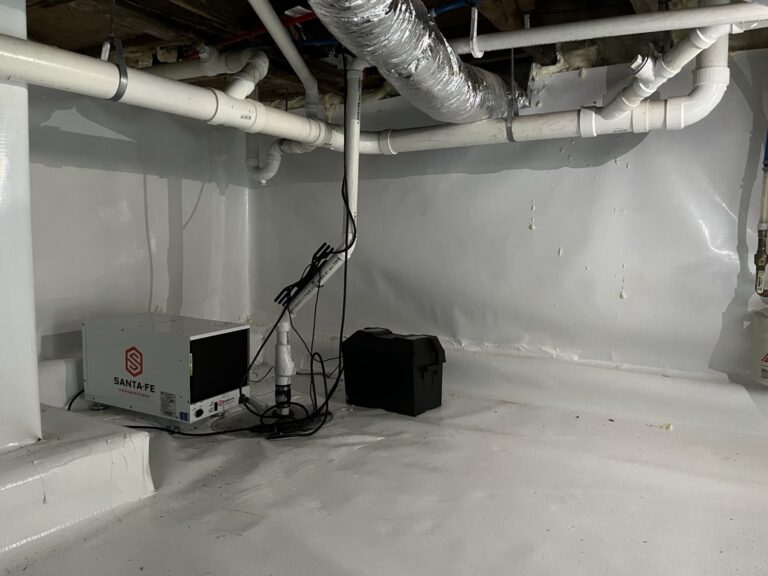
Exeter encapsulation includes a 25-year liner, wall-barrier, and workmanship warranty. Equipment terms remain separate and damage from later penetrations is not a failed seam.
Questions Exeter homeowners ask
Should Exeter crawl-space insulation be removed?
Damp, fallen, contaminated, or inspection-blocking material may need removal. The final insulation approach is chosen after the moisture boundary and framing condition are understood.
Can encapsulation go over a wet crawl floor?
Recurring liquid water should be collected and discharged first. The liner then completes the sealed system instead of hiding a puddle underneath.
What does the 25-year crawl warranty cover?
It covers the encapsulation liner, wall barriers, and installation workmanship. Dehumidifiers and other mechanical components carry their own terms.
Related help
See the full crawl space encapsulation service, find every town on the service-area map, or read straight answers to basement questions.
Get a free inspection in Exeter
We will look at the actual house, explain what needs attention and what does not, and give you a written estimate.
Housing-year reference: U.S. Census Bureau, 2023 ACS 5-year table B25035.
Common questions about crawl spaces
- If the humidity in your crawl space is 60-70% but in your house it’s lower, do you still need to fix the crawl space?
- Is a little water in a crawl space normal?
- Is a vapor barrier necessary under the subfloor?
- Is there a good ROI on crawlspace encapsulation?
- My home is on a crawl space; the problem is the $20k price tag. Is encapsulating a crawlspace worth the money?
- What are the potential disadvantages of having a crawl space under your house?
- What are the reasons for some houses having basements or crawl
- What are the top reasons for immediate house foundation repair and crawl space encapsulation?
- What challenges should I expect fixing squeaky floors in a house with a short crawl space?
- What is the difference between a crawl space and a basement?
- What is the difference between a moisture barrier and a vapor barrier?
- What should the humidity in a crawl space be at different times of year?