

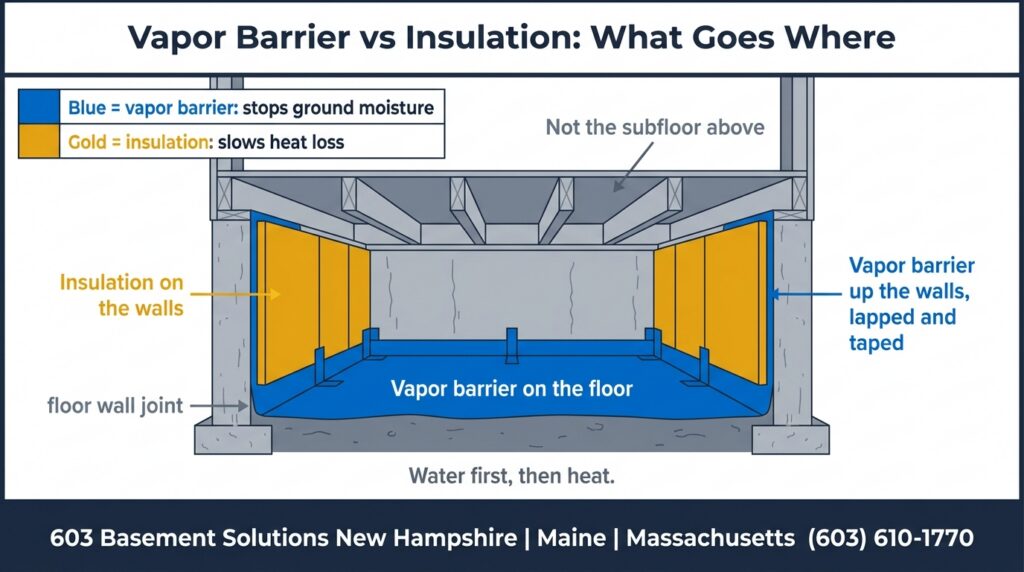
A vapor barrier and insulation do two different jobs. The vapor barrier stops ground moisture. Insulation slows heat loss. In a sealed crawl space the barrier goes on the floor and walls, and the insulation goes on the walls, not the subfloor above.
People mix these two up all the time. They hear “seal the crawl space” and grab a roll of fiberglass. Wrong order. We see it in New Hampshire crawl spaces all winter. Get the water handled first, then worry about heat. That order matters more here than it does in a warm climate, because a New England winter will find every gap you left. Here is what each part actually does and where it belongs.
What is the difference between a crawl space vapor barrier and insulation?
They fight two different problems. A vapor barrier is a heavy plastic sheet. It sits on the dirt and the walls and blocks water vapor coming up out of the soil. Think of it as a raincoat for the ground.
Insulation is a different animal. Fiberglass batts or rigid foam board. Its only job is to slow heat from leaving the house. Think of it as a sweater. A sweater does nothing to keep rain off you, and a raincoat does nothing to keep you warm. You need both, doing their own job, in the right spot.
The bare dirt in a crawl is the real moisture engine. The EPA is blunt about it. Crawl spaces with a bare earth floor are common sites for hidden mold, and the key to mold prevention is moisture control, keeping relative humidity under 60% (EPA, Mold Course). No amount of insulation does that. Only the barrier does.
Should you insulate a wet or vented crawl space?
Usually no. Not yet. If your crawl is damp, or the foundation vents are still open to the outside, insulation is the worst thing you can add. Here is why. Warm humid air hits the cold framing, it condenses, and now that moisture is trapped behind the batts against your wood. That is how you rot joists and grow mold you cannot even see.
We will say it plain. Do not let anyone sell you crawl space insulation before the water is dealt with. Dry it out. Seal the ground. Then insulate. Order matters more than the material.
Wet crawl already? Look for the tells first. Sagging floors, a musty smell upstairs, white powder on the block. Our rundown on the signs of an unhealthy crawl space walks through what to check before you spend a dime.
What goes where in a sealed crawl space?
In a sealed, conditioned crawl, the layout is simple once the water is out of the picture.
- The floor. A heavy vapor barrier over all the dirt. We run 20-mil on the floor because that is what gets walked on and dragged across rough ground. It has to take abuse.
- The walls. A heavy barrier up the foundation walls, lapped over the floor sheet and taped so it is one continuous skin. Code sets a minimum thickness and we go heavier than it, because the thin stuff tears. We confirm what your town requires for your house.
- Insulation. On the walls, not the subfloor. Rigid foam board against the foundation wall of a sealed crawl. The old vented way put fiberglass up in the subfloor between the joists, and that leaves you with cold floors and batts that fall down over time.
The Department of Energy lays out the same move. To convert a vented crawl to a sealed one, you close the vents, cover the ground with a sealed barrier, and insulate the foundation walls instead of the floor above (DOE, Building America). The DOE also notes that heat loss through the floor over a vented crawl is what gives you cold floors and a higher heating bill in the first place. Insulate the shell, not the ceiling.
On thickness, do not overthink it. There is a code minimum, and a real encapsulation runs heavier than it for durability. Thicker on the floor, a little lighter on the walls, all of it sealed together.
How does this tie into crawl space encapsulation?
The vapor barrier is one piece of encapsulation, not the whole thing. A real encapsulation is a system. Seal the vents. Line the floor and walls with a taped, continuous barrier. Insulate the walls. Then add a dehumidifier or a bit of conditioned air so the space stays dry year round.
Do the barrier alone and you have made a good start. Do the barrier plus wall insulation plus humidity control and you have a crawl space that stops feeding damp air into the house above it. That is the whole point. See how the full job comes together on our crawl space services page.
One thing worth saying plainly. If your crawl is bone dry, well drained, and already tight, you may not need the full package. Sometimes a good ground barrier is enough. We will tell you that to your face rather than sell you a system you do not need.
Frequently asked questions
Do I need a vapor barrier and insulation, or just one?
Most sealed crawls want both, but in order. The vapor barrier comes first because it controls moisture, and moisture is what wrecks the wood. Insulation comes after, on the walls, once the space is dry. If the crawl is damp, the barrier and drainage matter far more than insulation.
What thickness vapor barrier is best for a crawl space?
The code minimum works, but it tears easy. For a crawl you actually walk in or store things in, a real encapsulation uses a heavier sheet, with the thickest one on the floor where it takes the wear.
Can I insulate the crawl space floor instead of the walls?
That is the old vented approach, insulation up in the subfloor between the joists. In a sealed, conditioned crawl you insulate the foundation walls instead. The DOE recommends the wall approach when you close the vents, because it keeps the whole space inside the warm envelope of the house.
Will insulation stop my crawl space from being damp?
No. Insulation only slows heat loss. It does nothing to block ground moisture, and if you add it to a wet crawl you can trap water against the framing and grow mold. Fix the moisture with a barrier and drainage first, then insulate.
Is a vapor barrier the same as encapsulation?
Not quite. The vapor barrier is the plastic on the ground and walls. Encapsulation is the full system: sealed vents, a taped barrier on floor and walls, wall insulation, and humidity control. We price that work at $3,000 to $25,000 depending on the size of the space and how wet it is. The barrier is the biggest single piece, but it is one piece.
Not sure if your crawl needs the full system or just a ground barrier? We will come look and tell you straight. Call (603) 610-1770 or schedule your free inspection and we will figure out what your crawl space actually needs.