

Maybe, but not first. A dehumidifier belongs inside a sealed crawl space, not fighting an open dirt one. If your crawl is bare dirt and damp, seal it first. Drop a dehumidifier into an open crawl and it just chases wet air all season long.
Do I need a crawl space dehumidifier?
A dehumidifier is a good tool. On its own it won’t fix a wet crawl.
Think about where the water is coming from. Bare dirt gives off moisture every single day. Open foundation vents pull humid summer air right in. A machine down there is bailing a boat with the hole still in it.
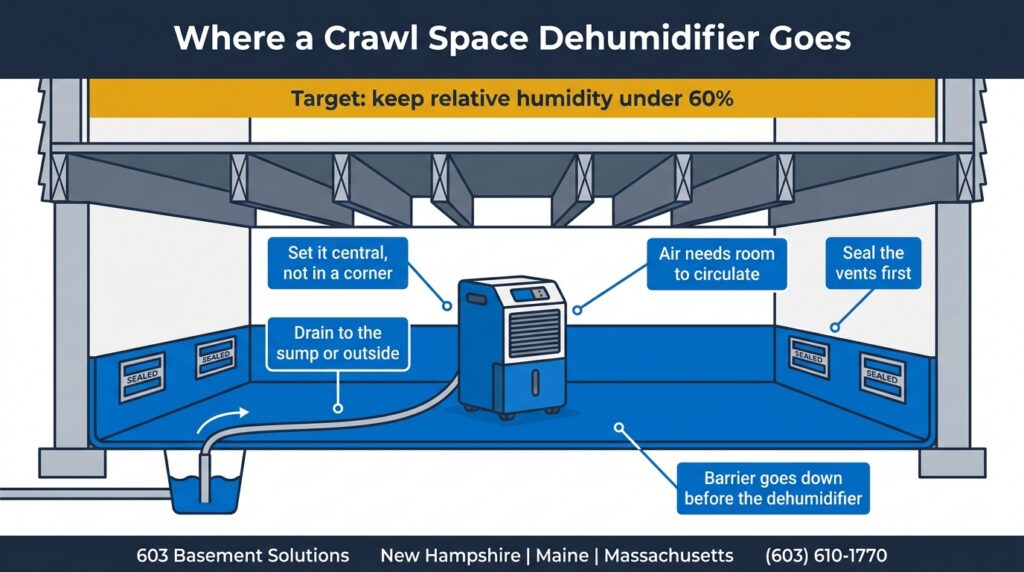
The EPA says keep indoor humidity below 60% to hold back mold and mildew. In an open dirt crawl a dehumidifier runs and runs and still can’t hold that line. Seal the ground and the vents first, then the machine has a real chance.
So the dehumidifier is one piece of a sealed system. It’s not a stand-in for sealing the crawl. That sealing is crawlspace encapsulation, and it’s the actual repair.
How do I choose a crawl space dehumidifier?
Once the crawl is sealed, pick the unit on three things.
- Pints per day for the square footage. That is the capacity. Sizing guides like Sylvane match pints pulled per day to the size of the space, roughly a rough rule of thumb is a pint of capacity for every 50 square feet once a vapor barrier is down. A small sealed crawl might want 30 to 40 pints a day. A big or damp one wants 70 or more.
- Low-temperature operation. This is the one folks miss up here. Most box-store dehumidifiers quit pulling water below about 65 degrees, and a New England crawl sits colder than that half the year. Buy one rated to run cold, or it just sits there dead in January.
- A built-in pump or a gravity drain. Nobody wants to crawl under the house to empty a bucket. A unit with a built-in pump can push the water up and out. If the grade lets water run downhill on its own, a plain gravity drain to a sump or out to daylight works fine and there’s less to break.
On money, a crawl space dehumidifier runs about $300 to $2,000 for the unit alone, or $1,000 to $3,000 installed (HomeGuide, 2026). Here is how that splits out.
| What you’re buying | Typical range | Source |
|---|---|---|
| Dehumidifier unit only | $300 to $2,000 | HomeGuide, 2026 |
| Unit plus professional install | $1,000 to $3,000 | HomeGuide, 2026 |
Those are national numbers, not a 603 quote. We do not sell a dehumidifier on its own. Ours comes as part of a sealed crawl space, where the vapor barrier, the insulation, the sump and the dehumidifier all do one job together. That work runs $3,000 to $25,000 depending on the size of the space and how wet it is, and you get the number after we look at it, not before. Your crawl sets the real price.
Where should a crawl space dehumidifier go?
Put it near the middle of the crawl, not jammed in a far corner. Air has to move around it to do any good.
Keep it up off the dirt. Set it on a stand or hang it, so it sits on the vapor barrier and not in a puddle. Run the drain line downhill to a sump pump or out to daylight, and make sure that line can’t kink. One unit covers most homes. A long or chopped-up crawl with walls between sections may need the air ducted over, or a second unit.
Dehumidifier vs. a conditioned crawl space
A conditioned crawl space is the whole job done right. You seal the dirt with a heavy vapor barrier, close the foundation vents, insulate the walls, then let a dehumidifier or a little conditioned air hold the room steady.
The Department of Energy reports 10% to 30% lower energy bills when a crawl is sealed and insulated well. The dehumidifier is one part of that, not the whole thing.
So it isn’t really machine versus sealed crawl. A dehumidifier alone in a wet dirt crawl is the losing battle. That same machine inside a sealed, conditioned crawl earns its keep and barely has to run. If you’re not sure which camp your crawl is in, watch for the signs of an unhealthy crawl space first.
Frequently asked questions
Will a dehumidifier fix a wet dirt crawl space?
No, not by itself. Bare ground keeps feeding moisture and open vents keep letting damp air in. Seal the crawl first with encapsulation, then a dehumidifier keeps it dry. Run one alone in an open crawl and you’re paying to run a machine that never catches up.
What size dehumidifier do I need for my crawl space?
Size it by pints pulled per day against your square footage. A sealed crawl under 1,500 square feet often does fine on 30 to 40 pints a day, and a larger or damper one wants 70 or more (per sizing guides like Sylvane). Bigger isn’t always better, so match it to the space.
Do I need a special dehumidifier for a cold New England crawl space?
Yes. Standard units stop pulling water below about 65 degrees, and our crawls run colder than that a good part of the year. Look for a model rated for low-temperature operation so it keeps working through the cold months.
Where should I put the dehumidifier in my crawl space?
Near the center, up off the dirt on a stand or hung, with the drain running downhill to a sump or out to daylight. Give it room so air can move around it. Don’t bury it in a corner behind the ductwork.
Is it cheaper to just run a dehumidifier instead of encapsulating?
It looks cheaper on day one. It usually isn’t, once you add up years of a machine grinding away in a crawl it can’t win. Encapsulation deals with the water at the source, so the dehumidifier does light duty after that. And we’ll tell you straight if your crawl only needs the machine and not the full job.
Not sure if your crawl needs the full seal or just a good machine? We’ll come look and tell you straight. Call (603) 610-1770 or schedule your free inspection and we’ll walk your crawl with you.