
Treat crawl space wet rot in three moves. Dry the space out first, then sister or replace the rotted wood, then encapsulate so the water never comes back. Wet rot lives on a steady water source. Cut off the water and the rot stops cold.
That order matters. Skip the drying step and you’re just feeding new wood to the same fungus. Below is how to tell what you’ve got, what caused it, and when it stops being a cleaning job and starts being a structural one.
What is the difference between wet rot and dry rot?
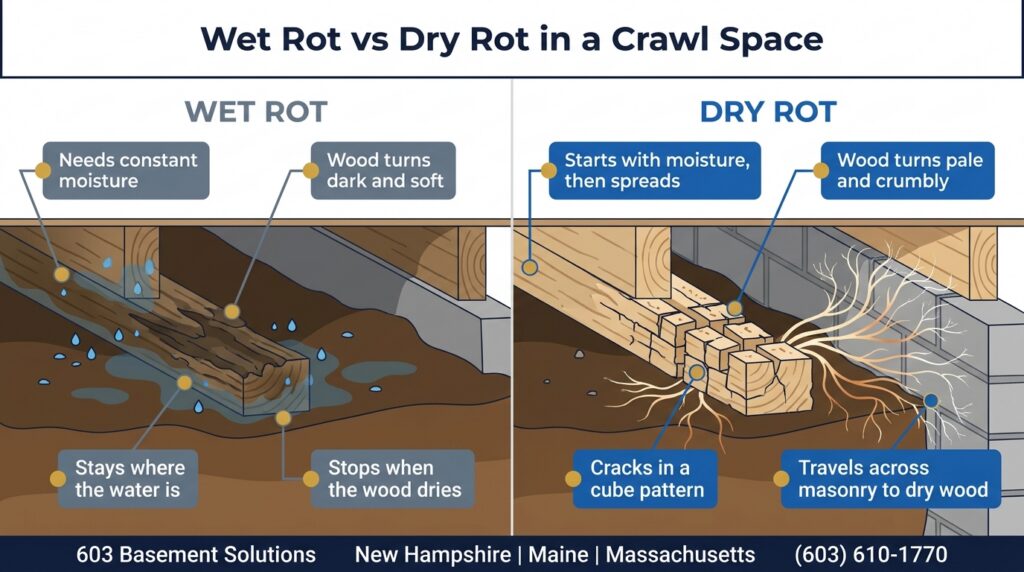
Both are fungus eating your framing. The difference is how wet the wood has to be and how far the rot will travel.
Wet rot is the common one under New England houses. It needs wood that stays soaked, and it mostly stays put right where the water is. Decay fungi take hold once wood stays damp and keep going as long as it stays that way. The good news with wet rot is simple. Dry the wood out and the fungus dies.
Dry rot is rarer and meaner. It can run stringy strands across masonry and carry its own moisture into wood that looks dry. The name is a lie. It still needs a wet start, it just doesn’t stay politely near the leak. If you’ve got dry rot, you want a pro looking at it fast.
What are the warning signs of crawl space wood rot?
You usually smell it before you see it. Here’s what to look for when you get a light down there:
- A heavy musty, earthy smell that hits you at the hatch.
- Dark staining or a wet, dark sheen on the joists and the sill.
- Wood that feels soft or spongy when you press a screwdriver into it.
- Wood that crumbles, or brown wood that cracks into little cubes.
- White stringy growth or fine cottony patches on the framing.
- Floors above that feel bouncy, springy, or sag near a wall.
- Mushrooms or fine sawdust sitting on the dirt or the barrier.
A little surface mildew that wipes off the bottom of a joist is not structural rot. Mildew is a moisture warning, not a strength problem. If the wood underneath is still hard, don’t let anyone talk you into a tear-out. Wipe it, dry the space, and keep an eye on it. For the full picture of a crawl gone bad, see our list of the signs of an unhealthy crawl space.
What causes wood rot in a crawl space?
One thing, really. Water. It just gets to the wood three different ways.
Standing water on the dirt. Bad grade outside, clogged gutters, or downspouts dumping at the foundation, and rain ends up puddling on the crawl floor. If a sump is running nonstop, that’s a flag too. Our page on a sump pump that keeps running walks through why.
High humidity all summer. A bare dirt floor pumps moisture straight up into the air, and that damp air soaks right into the framing. The wood never gets a chance to dry. The EPA is blunt about it in its Brief Guide to Mold, Moisture and Your Home: moisture control is the whole game, and crawl spaces with bare earth floors are classic hidden trouble spots.
Wicking at the floor wall joint. Where the ground meets the foundation wall, water pushes in along that floor wall joint and keeps the sill and the bottom of the framing wet for weeks. That’s why the sill plate is so often the first thing to go.
How is crawl space wood rot treated?
Same three moves, in this exact order. Get it out of order and you’ll be back down there in two years.
1. Dry the space first. Fix the water before you touch a board. Regrade the dirt away from the house, clean the gutters, extend the downspouts, and add a sump if there’s real standing water. The EPA says wet material should dry inside 24 to 48 hours or mold sets in, and a crawl that stays wet never gets that window. Run a dehumidifier to dry the framing out and hold it there.
2. Then sister or replace the rotted wood. A short soft spot on an otherwise good joist gets a sister, a fresh board bolted alongside the healthy wood to carry the load. Wood that’s gone soft along a whole wall, like a rotted sill, gets cut out and replaced. That’s real structural work and the loads have to be carried while it’s done. See what goes into it on our page for the cost to replace a rotting sill beam.
3. Then encapsulate so it doesn’t come back. This is the step that makes the first two last. Lay a heavy vapor barrier over all the dirt, run it up the walls, seal the seams, and set a dehumidifier to keep it dry. The building code backs the idea. It calls for a ground cover on any crawl, and a sealed, encapsulated crawl goes well past that minimum with a continuous barrier taped up the walls. Encapsulation runs $3,000 to $25,000 with us, depending on the size of the crawl and how wet it is, and you get that number after we look at it, not before. Full details on our crawl space repair and encapsulation.
When does crawl space rot become structural?
Rot turns structural when it’s eating the pieces that hold your house up, not just staining the surface. The tells are hard to miss once you know them.
- Floors upstairs that feel soft, bouncy, or dip toward a wall.
- A joist or beam you can sink a screwdriver into with light pressure.
- A post or lally column that’s leaning, or a beam that’s sagging over it.
- A sill plate that crumbles when you poke it.
At that point it’s not a dehumidifier fix. Those members have to come out and get replaced, with the house properly supported while the work happens. This is where you want a crew that self-performs structural repair in-house instead of subbing it out, so one team owns the whole job. That’s the work we do across New Hampshire across New Hampshire, Maine, and Massachusetts.
Frequently asked questions
Can wet rot spread to the rest of the house?
Wet rot usually stays close to the water, so it tends to stay in the crawl. Dry rot is the one that can travel into dry wood. Either way, the fix starts with cutting off the moisture.
Will drying the crawl space stop the rot on its own?
Drying stops it from getting any worse, which is huge. But drying does not put strength back into wood that’s already gone soft. That wood still has to come out and get replaced.
Do I have to replace the whole beam or just the rotted part?
Depends how far the rot runs. A short soft spot can often be sistered with a new board alongside the good wood. Rot along a whole wall usually means replacing the full sill or beam.
Is a musty smell always rot?
Not always. Damp dirt and mildew smell musty too. But a musty crawl always means moisture, and moisture is exactly what feeds rot. If you smell it, get it checked before it becomes structural.
Can I treat crawl space rot myself?
You can handle the water side. Improve the grade, clean the gutters, run a dehumidifier. Cutting out structural wood while it’s carrying the weight of the house is not a DIY job, and you can make things worse fast.
Worried about soft floors or a musty crawl?
We’ll tell you straight whether it’s surface mildew you can wipe or real rot that has to come out. No scare tactics. Call 603 Basement Solutions at (603) 610-1770 or schedule your free inspection and we’ll take a look.