

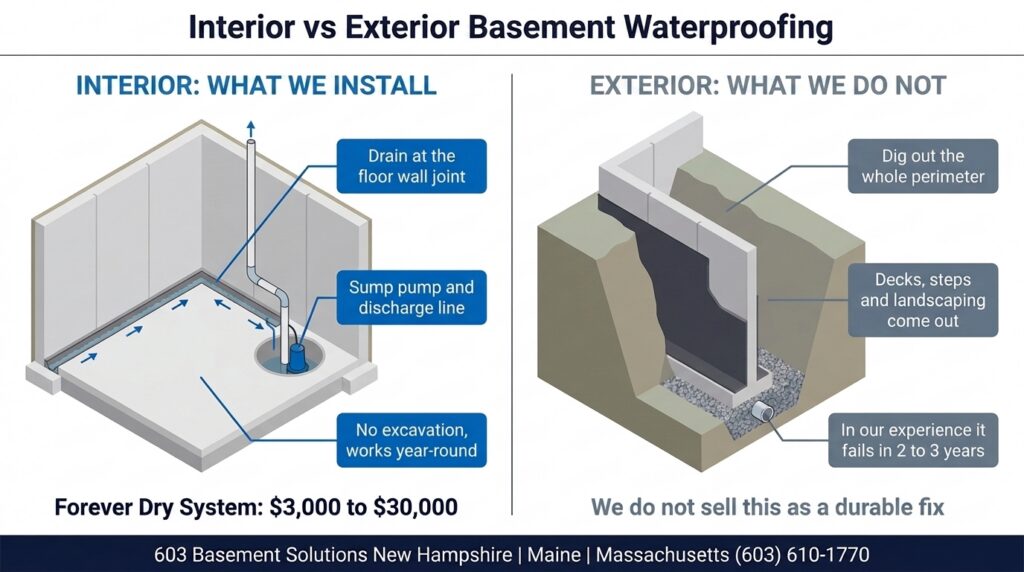
Most New England basements get waterproofed from the inside. You cut a channel into the floor wall joint, run it to a sump pump, and give the water somewhere to go. Exterior digging works too. It just costs a lot more, and it rarely earns the difference.
Water doesn’t come through the middle of a poured wall. It finds the seam where the floor meets the wall. That seam is the floor wall joint, and it’s where almost every wet basement up here starts.
How do you waterproof basement walls?
Two ways. From the inside, or from the outside.
- Interior. You manage the water once it reaches the wall. A drain gets cut into the floor wall joint, gravel and pipe go in, and it feeds a sump pump that pushes the water back outside.
- Exterior. You stop the water before it ever touches the wall. Crews dig down the whole outside of the foundation, coat the wall with a membrane, and lay a drain pipe at the footing.
Both keep a basement dry. The real difference is cost, mess, and what your house actually needs.
Interior vs exterior waterproofing: which is better?
For most homes in NH, interior drainage plus a sump pump is the smart, durable pick.
Going exterior means digging up the entire perimeter of your house. Decks, steps, walkways, the mature landscaping. All of it comes out. Then you backfill, and disturbed backfill keeps settling for years. Our ground freezes hard every winter on top of that, so frost heave keeps working on whatever you buried out there.
An interior drain never touches your yard. It sits under the slab, below the frost, and it just keeps running. HomeGuide puts interior French drains and sump pumps at 20 to 30 years of service life (HomeGuide, 2026). That’s the long-lived part of the whole job.
Our Forever Dry System is exactly this. An interior waterproofing system for the basement. A drain at the floor wall joint, tied into a sump pump. We don’t sell exterior-excavation waterproofing as our durable fix, because for the wet basements we actually see, the inside route does the same job for less money and a lot less damage to your property.
When is exterior waterproofing actually needed?
Sometimes it is the right call. We’ll tell you straight when that’s the case.
- One foundation crack leaking from the outside, where digging to that single spot is cleaner than chasing it in.
- A wall that’s bowing from soil pressure and needs the weight of that dirt taken off before anything else. That’s a structural repair, not a coat of anything.
- A new build where the exterior membrane got skipped or botched and the backfill is still open.
Outside of cases like those, exterior excavation is usually more project than the problem calls for. A dry basement doesn’t require tearing up your yard.
Why do DIY wall sealants and paint-on waterproofers fail?
Because they only coat the surface. They do nothing about the pressure behind it.
When the ground outside gets soaked, water builds pressure against the foundation. That pressure hunts for the weak seam. The weak seam is the floor wall joint. A paint-on sealer on the wall face can’t hold that back, so the water pushes up through the joint at the bottom, and now your fresh coat is peeling off in sheets.
HomeGuide says it plain. Waterproof paint and concrete sealers “won’t stop water under pressure” (HomeGuide, 2026). They run about $2 to $10 a square foot and they’re fine for light dampness. For an actual leak, you’re just painting over the problem.
If it’s only a little damp after a hard rain, don’t let anyone sell you a full system. Seal the crack, keep an eye on it, and don’t spend money you don’t need to.
What does waterproofing basement walls cost?
Our Forever Dry System runs $3,000 to $30,000. That is a wide range because basements are not the same. What moves your number is how much wall we have to drain, how much water is actually coming in, and what the pump and the discharge line need to do about it.
| What drives your price | What we are looking at |
|---|---|
| How much perimeter | Linear feet of drain we cut into the floor wall joint |
| How wet it is | Seepage in one corner, or water coming up across the whole floor |
| Pump and discharge | We set one half-horsepower sump pump per 120 feet of drainage, and the line has to run somewhere sensible |
| Wall condition | Cracks that need sealing, and whether the wall is moving or just wet |
You get your number after we see the water, not before. The inspection and the estimate are free, and we will tell you if the fix is smaller than you feared.
Frequently asked questions
Can you waterproof a basement from the inside only?
Yes, and most of the time that’s all it takes. An interior drain in the floor wall joint feeding a sump pump handles the water, and nobody has to dig up your yard to do it.
Does waterproof paint actually work?
Not against real water. It coats the wall face, but the pressure pushes up through the floor wall joint and the paint peels. It’s fine for light dampness. It won’t hold back a leak (HomeGuide, 2026).
How long does interior basement waterproofing last?
HomeGuide puts interior French drains and sump pumps at 20 to 30 years with basic upkeep (HomeGuide, 2026). Keeping the sump pump maintained is most of that upkeep.
My sump pump won’t stop running. Is that a waterproofing problem?
Could be. A pump that never shuts off can mean a high water table, a stuck float, or a bad check valve. We walk through the usual causes in sump pump keeps running: causes and fixes.
Do I have to dig up my landscaping to fix a wet basement?
Usually not. Exterior excavation is for specific cases like an outside crack or a bowing wall. For a standard wet basement, an interior system keeps your yard right where it is.
Not sure which way your basement needs to go? We’ll come look, tell you straight, and put it in writing. Call (603) 610-1770 or schedule your free inspection. We’ve done 5,000-plus of these across NH, ME, and MA, and we don’t cut corners.