
Quick Answer
603 Basement Solutions installs helical piers in Exeter, NH after an inspection confirms foundation settlement. The crew advances each pier, prepares the connection, and transfers the building load through a foundation bracket. 603 treats stabilization and structural lifting as different outcomes with different risks. 603 currently charges $2,700 each for the first three piers, then $2,200 each. Start with a free inspection.
Helical Pier Installation in Exeter: What We Inspect
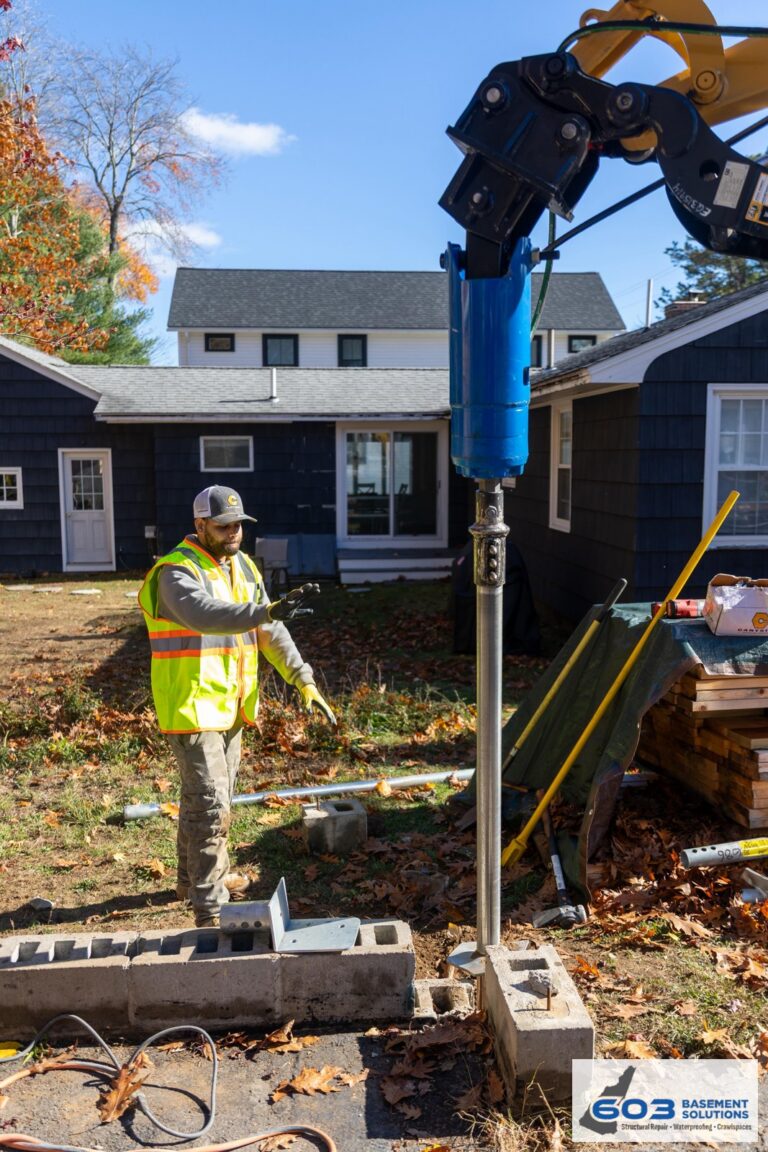
Piers under an addition, before the concrete goes in
Helical piers are not only a repair. They are also a foundation method, used under new additions and structures where the ground will not carry a conventional footing.
Deciding that before the concrete is poured is far cheaper than deciding it afterwards. The equipment is the same and the sequence is much simpler.
What the Exeter housing figures do not settle
The 2023 American Community Survey places the median Exeter housing unit at 1978, with roughly 22 percent of units built before 1940.
An addition to an older house joins two different structures. What the new section bears on is a design question, not an assumption to inherit.

Signs Your Foundation May Need Helical Piers in Exeter
These signs justify a closer look, but none of them proves the repair by itself.
An addition is planned on soft ground
Piers can carry the new structure without waiting for settlement to prove the point.
The new section will join an old house
Two structures on different footings will move differently unless the design accounts for it.
A deck or porch keeps moving
Light structures on shallow footings are a common candidate for screwed piers.
Excavation would undermine the house
Piers can avoid digging beside an existing foundation.
A deck keeps settling
Shallow footings on soft ground are a common pier candidate.
When Helical Piers Are the Right Repair, and When They Are Not
When they may fit
- One section is actively sinking: Repeat readings or related movement establish a foundation-support problem.
- A sound connection is available: The proposed bracket can attach to a suitable footing or wall section.
When another answer may be better
- The evidence is only cosmetic: Drywall or mortar damage alone cannot determine a structural method.
- Water enters a stable opening: Leak repair and drainage belong to a different scope than underpinning.
How 603 Diagnoses Foundation Settlement in Exeter
For new work the visit starts with the design rather than a symptom. What is being built, what it will weigh, and what the ground is expected to carry.
Where an existing house is involved, we look at what it currently bears on and how the new section is meant to connect to it.
The written finding covers pier locations, the assumed loads, the engineering responsibility and the records that will be handed over at completion.
How 603 Installs Helical Piers in Exeter
- Inspect the structure and confirm which section is settling.
- Lay out bracket locations and verify a workable equipment route.
- Rotate each pier into the ground until the required installation resistance is reached.
- Prepare sound structure at each location and fasten the pier bracket.
- Transfer the load and perform only the stabilization or approved lift in the scope.
- Close the job with location records, project photographs, and warranty terms.
Examples of Helical Pier Installation by 603 Basement Solutions
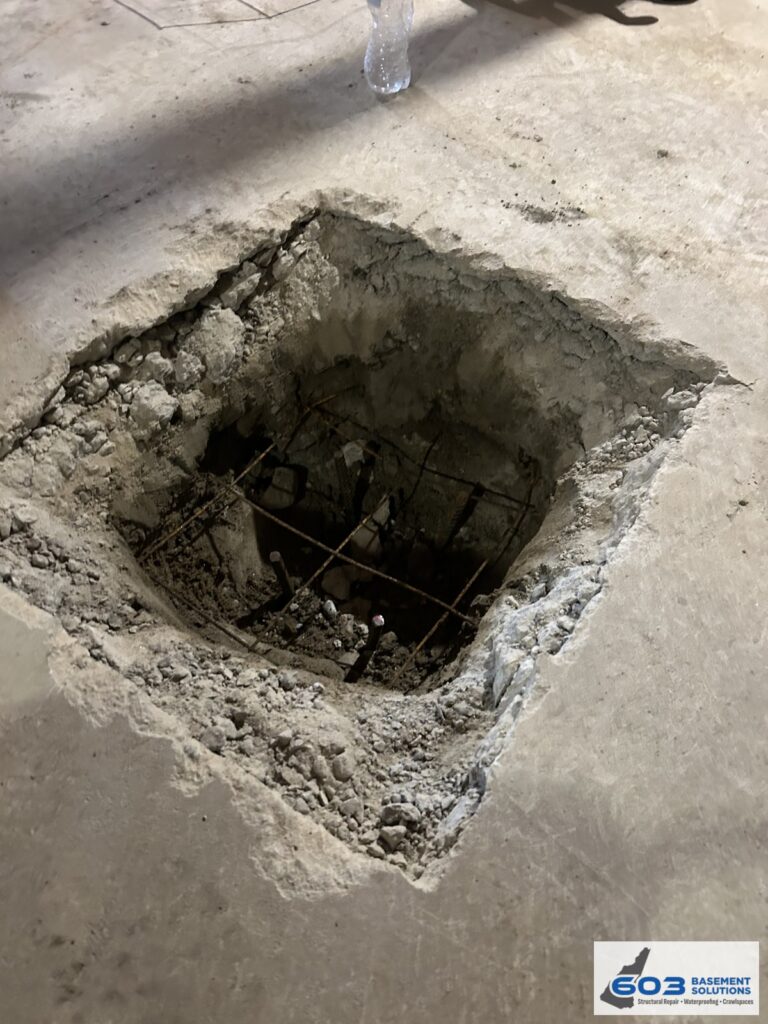
These photographs show real 603 crews and repair details. They explain the method without presenting the work as a verified Exeter project.
Foundation Repair Decisions for a Exeter Home
Design the connection, not just the support
Where a new section meets an existing house, the joint is the part that shows problems first. It deserves attention at design stage.
Ask how the two structures are intended to behave together. Independent movement is sometimes the right answer and should be a decision.
Use the ground conditions you have
A conventional footing needs soil that can carry it near the surface. Where that is absent, piers reach past the problem rather than hoping it improves.
That choice is cheaper before construction. Retrofitting support under a finished structure costs more and disturbs more.
Helical Pier and Underpinning Methods for Exeter Homes
What the helix actually does
The plates welded to the shaft are what generate capacity. As the pier advances, those plates bear against progressively firmer material until the required resistance is reached.
Because the machine turns the shaft rather than pressing on the building, the weight of the house does not limit the installation.
When both types appear on one job
Different parts of a structure can call for different support, and a plan that mixes them is not inconsistent.
What matters is that the drawing says which method goes where, and why that section got the one it did.
Helical Pier Cost in Exeter, NH
Piers one, two, and three currently cost $2,700 each through 603. Each additional pier costs $2,200. The schedule supplies unit pricing, while the inspection establishes whether piering fits and where. Access, footing condition, supported load, restoration, and a proposed lift can all change the wider scope.
See the helical pier cost guide for worked examples.
Foundation Stabilization vs Structural Lifting
A stabilized foundation should hold at the treated locations. Lifting goes further by trying to regain part of the previous height. Moving the building can disturb finishes and rigid services. The written scope should define where the crew stops.
Why Homeowners Choose 603 for Helical Pier Installation
- Warranty language is tied to the installed piers and its stated conditions.
- The team that diagnoses the settlement also performs the helical installation.
- The repair method follows the measured problem rather than a product-first pitch.
- The proposal identifies the affected section and the intended structural outcome.
Helical Piers vs Push Piers
The helical method turns a shaft through the soil until the required resistance is reached. With push piers, the building supplies the opposing force. Lightweight construction can limit that approach. The choice follows the load, access, footing, and installation plan. Read the helical pier versus push pier comparison for the full decision.
What a Exeter Helical Pier Proposal Should Contain
An Exeter proposal for new work should show pier locations on the same drawing as the framing and the footing. Support and structure belong on one plan.
It should state how the new section is intended to behave relative to the existing house, and what the connection detail assumes.
Questions to Ask Before Helical Pier Work in Exeter
- Raise it at design stage. Ask about ground conditions before the footing detail is finalised.
- Decide how the structures connect. Confirm whether the addition is intended to move with the house or independently.
- Locate the piers on the plan. Put pier positions on the same drawing as the framing and the footing.
- File the installation record. Keep locations, depths and readings with the permit and drawings.
Helical Pier Decisions to Keep Separate in Exeter
Is this repair, or is it foundation design?
New construction is a design decision. Treating it as a repair skips the questions that matter.
Is the addition tied to the house, or independent?
Both can be correct. Only one of them should be an accident.
Helical Pier Questions from Exeter Homeowners
Can helical piers support a new addition?
Yes. They are used as a foundation method where surface soils will not carry a conventional footing.
Is it cheaper before or after construction?
Before, and by a wide margin. Retrofitting support under a finished structure costs more and disturbs more.
Will the addition move with the house?
That should be a design decision rather than an outcome. Ask how the connection is intended to behave.
Can piers support a deck or porch?
Yes. Light structures on shallow footings are common candidates.
Do I need an engineer?
Often for new construction. The proposal should say who is providing that and whether it is included.
What You Receive After a Exeter Inspection
For new work the document covers pier locations, assumed loads and who carries the engineering responsibility. Those three decide most of the price difference between bids.
It also states how the new section is intended to behave relative to the existing house. Independent movement is a design choice and should be recorded as one.
Have the Exeter movement checked
We will trace the load path, locate any support that is needed, and hand you a scope you can compare.
The ACS figure quoted here comes from the U.S. Census Bureau, 2023 ACS 5-year table B25035. Rates, warranty length and crew information come from 603 directly. Photographs show 603 work. For the method see Helical and Push Piers; for everything structural see the Structural and Foundation Repair hub. Foundation Crack Repair in Exeter handles stable openings. Service Areas shows the towns we cover.