
Quick Answer
For measured foundation settlement in Hampton, 603 Basement Solutions may recommend helical pier installation. Installation continues to the required resistance; the bracket then gives the sinking area a new support path. 603 treats stabilization and structural lifting as different outcomes with different risks. Current method pricing is $2,700 per pier for the first three, then $2,200 per pier. 603 inspects at no charge.
Helical Pier Installation in Hampton: What We Inspect
Name the outcome before anyone counts piers
Stabilising and lifting sound like the same purchase. They are not, and the gap between them is where most disappointment with pier work begins.
Decide which one the house needs first. The pier count, the sequence and the evidence at the end all follow from that decision.
What the Hampton housing figures do not settle
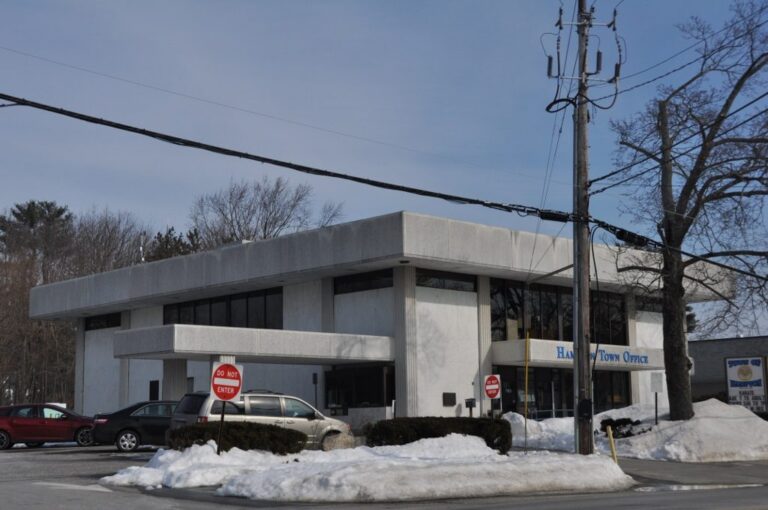
The 2023 American Community Survey places the median Hampton housing unit at 1978. That townwide midpoint describes the housing stock, not one foundation.
What the address records is more useful. Additions, converted spaces and reworked openings all change how load reaches the ground.
Signs Your Foundation May Need Helical Piers in Hampton
These signs justify a closer look, but none of them proves the repair by itself.
The floor slopes toward one corner
Decide whether the goal is to stop the movement or to reduce the slope.
A door has stopped latching
Note it before work starts, because lifting can change how it closes again.
Tile or stone runs through the area
Rigid finishes deserve a written expectation before any attempted lift.
The settlement looks old
An old movement can be dormant. Repeat measurement is what separates the two.
A sunroom or addition is involved
Light structures can move independently of the main house.
When Helical Piers Are the Right Repair, and When They Are Not
When they may fit
- A sound connection is available: The proposed bracket can attach to a suitable footing or wall section.
- Bearing beneath the footing is failing: The structure needs support at a deeper and verified point.
When another answer may be better
- The evidence is only cosmetic: Drywall or mortar damage alone cannot determine a structural method.
- A shallow interior support failed: Column or beam repair may restore that load path without foundation piering.
How 603 Diagnoses Foundation Settlement in Hampton
We start by asking what the house is doing now, not only what it did. A settlement that stopped years ago calls for a different answer than one still moving.
Floor elevations, door and window behaviour, and the condition of finishes near the affected area all get recorded before any method is discussed.
Where lift is being considered, the survey is more detailed. The points that will be re-read afterward are chosen and marked on the day, not improvised at the end.
How 603 Installs Helical Piers in Hampton
- Inspect the structure and confirm which section is settling.
- Lay out bracket locations and verify a workable equipment route.
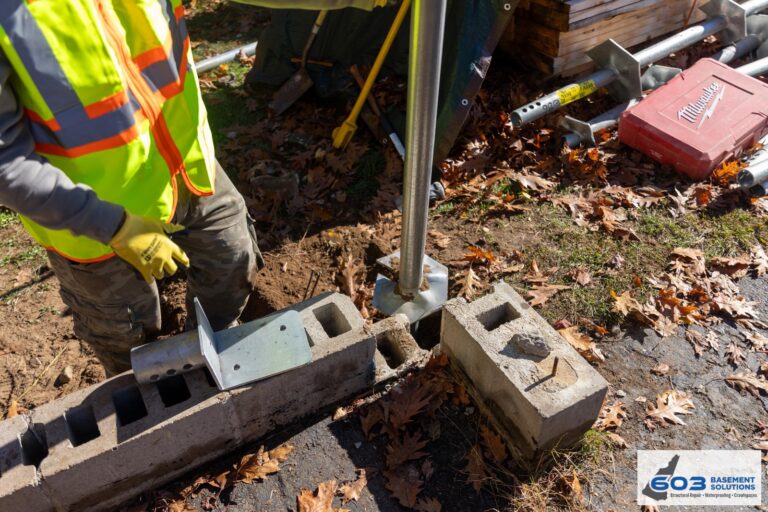
- Rotate each pier into the ground until the required installation resistance is reached.
- Expose the connection point, confirm its condition, and attach the bracket.
- Transfer the load and perform only the stabilization or approved lift in the scope.
- Close the job with location records, project photographs, and warranty terms.
Examples of Helical Pier Installation by 603 Basement Solutions
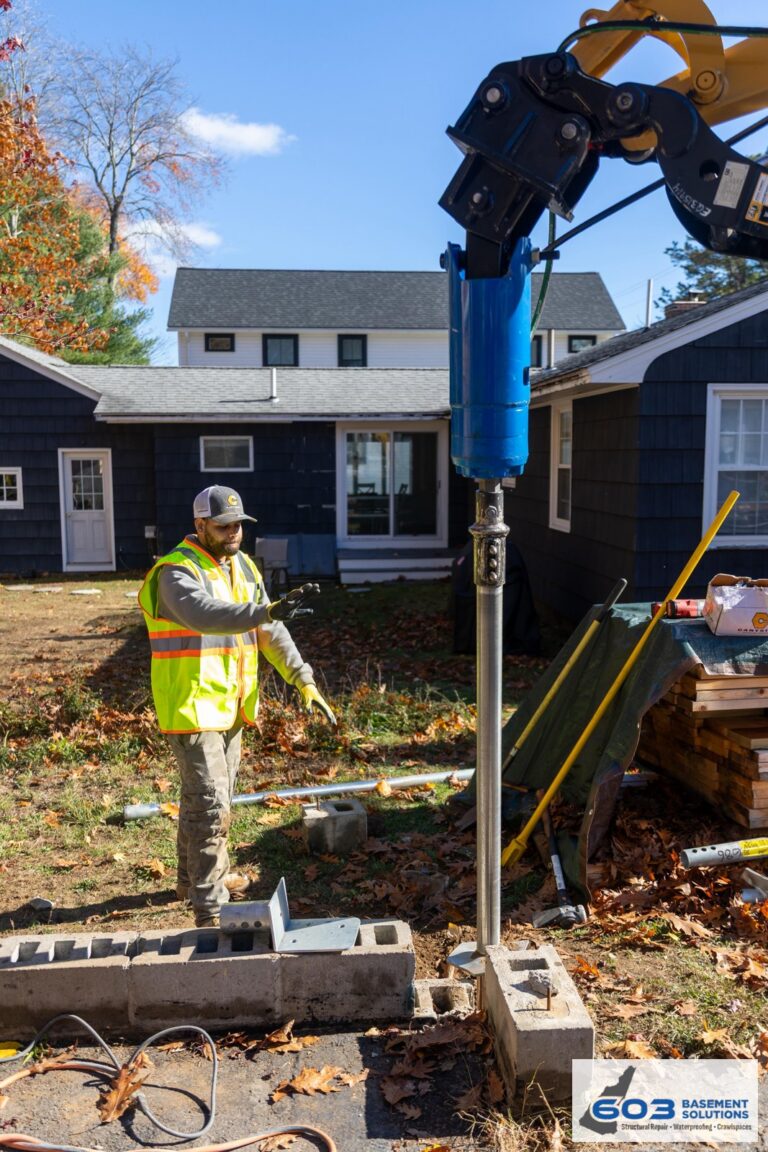
These photographs show real 603 crews and repair details. They explain the method without presenting the work as a verified Hampton project.
Foundation Repair Decisions for a Hampton Home
Write the target, not just the method
Stabilisation says the structure will not settle further at the treated locations. Attempted lift says something more, and it accepts more risk to get there.
A proposal should state which it is buying in plain words. If it says both, ask which one the warranty actually covers.
Photograph the finishes first
Lifting moves the structure and everything fixed to it. Plaster, tile, trim and rigid plumbing can respond, sometimes visibly.
Record their condition before mobilisation. That record is what makes an honest conversation possible afterwards.
Helical Pier and Underpinning Methods for Hampton Homes
The risk nobody prices by accident
Moving a settled structure upward puts stress into finishes that have long since adjusted to their current position.
Plaster, tile, rigid plumbing and masonry can all respond. A scope that attempts lift should say what it will do when they do.
Load transfer, in one paragraph
The point of a pier is to move weight off soil that is failing and onto material that is not. Everything else about the method serves that single transfer.
Until the bracket is fastened and loaded, nothing has actually changed for the house. The connection is the repair, not the shaft.
Helical Pier Cost in Hampton, NH
Current method pricing starts with three piers at $2,700 each, followed by $2,200 for every added pier. A final scope cannot come from a rate alone. 603 first identifies the section that needs support. Access, footing condition, supported load, restoration, and a proposed lift can all change the wider scope.
See the helical pier cost guide for worked examples.
Foundation Stabilization vs Structural Lifting
Stabilization is intended to stop further movement at the treated section. An attempted lift asks the system to recover some lost elevation. A lift may move drywall, flooring, masonry, or pipes along with the structure. Expectations belong in writing.
Why Homeowners Choose 603 for Helical Pier Installation
- The team that diagnoses the settlement also performs the helical installation.
- 603 self-performs its helical installations and structural lifting work.
- Real 603 project photographs show the equipment, pier, and connection work.
- The written scope gives homeowners a concrete plan to compare.
Helical Piers vs Push Piers
A helical shaft is screwed into place using installation equipment rather than the weight of the house. Push piers use the structure as the reaction load, which can make them suitable for heavier buildings. The choice follows the load, access, footing, and installation plan. Read the helical pier versus push pier comparison for the full decision.
What a Hampton Helical Pier Proposal Should Contain
A Hampton proposal should open with the outcome in plain language. If the goal is to stop movement, it should say so, and it should not imply recovery of elevation it cannot deliver.
It should list the vulnerable finishes near the work and state what happens if they move. Tile, plaster and rigid plumbing runs deserve naming individually rather than a general disclaimer.
Questions to Ask Before Helical Pier Work in Hampton
- Set the goal in one sentence. Write down whether the outcome is stabilisation or attempted lift before comparing prices.
- Record the starting elevations. Use fixed points and keep the file, because it is the only baseline you will have.
- List the vulnerable finishes. Photograph tile, plaster, trim and any rigid runs near the work.
- Agree the stop condition. For attempted lift, ask what would cause the crew to stop early and how that is decided.
Helical Pier Decisions to Keep Separate in Hampton
Is the goal support, or is it elevation?
Stopping movement and recovering height are separate purchases. A scope that blurs them cannot be judged afterwards.
Is the finish damage structural, or cosmetic?
Both can be present. Repairing plaster does not stabilise a footing, and stabilising a footing does not repair plaster.
Helical Pier Questions from Hampton Homeowners
Will helical piers lift my Hampton house back to level?
Sometimes partially. Lift is attempted where conditions allow, and no honest proposal promises a return to original elevation.
Is stabilising enough?
Often, yes. If the structure stops moving and the finishes are acceptable, further lift may add risk without adding value.
Does lifting crack the plaster?
It can. That is why the finish condition is documented first and the limits are written into the scope.
Where does 603 travel from?
The crews work out of East Kingston, which is a short run to Hampton.
Should I wait and see whether it gets worse?
Sometimes that is the right call, and it is a decision made from repeated readings rather than from a single visit.
What You Receive After a Hampton Inspection
You receive the written scope with the outcome stated in the first line. Stabilisation and attempted lift are named, never blended into one phrase.
The elevation readings taken on the day come with it. Those points get re-read afterwards, so they belong in your file as well as ours.
Get a written Hampton finding
We will tell you if the honest answer is to wait and measure again.
Sources: U.S. Census Bureau, 2023 ACS 5-year table B25035. Prices, warranty and self-performance details are 603’s own. The work photographs show 603 installations. More on the method at Helical and Push Piers. The full structural service sits on the Structural and Foundation Repair hub. A stable crack belongs with Foundation Crack Repair in Hampton. Our coverage map is on Service Areas.