
Quick Answer
In Peabody, 603 uses helical piers only after measurements connect the visible damage to foundation movement. The crew advances each pier, prepares the connection, and transfers the building load through a foundation bracket. Stabilization is the primary promise, while lifting must be evaluated and written separately. Current 603 pricing is $2,700 per pier for the first three and $2,200 for each additional pier. The inspection is free.
Helical Pier Installation in Peabody: What We Inspect
Start at the top of the load path, not the bottom
The lowest visible thing is rarely the failing thing. Weight arrives at the foundation through framing, beams and posts, and any of those can be the weak handoff.
Working down from the affected rooms usually locates the problem faster than working up from the crack that prompted the call.
Reading the Peabody housing numbers honestly
Peabody’s median housing unit dates to 1966 in the 2023 American Community Survey. A median is a midpoint, so half the stock is older and half is newer.
Neither half describes your footing. Plans, permits and photographs from the property are the documents that actually apply.
Signs Your Foundation May Need Helical Piers in Peabody
These signs justify a closer look, but none of them proves the repair by itself.
The house sold recently
Inspection reports from the sale are worth pulling before anything is measured again.
The floor was levelled with self-levelling compound
That hides the original elevations. Say so, because it changes what a reading means.
One exterior corner sits low
Match the outside reading to the rooms above and the footing below it.
Framing was altered for an open plan
Removed walls change what carries the floor above, sometimes without a beam sized for it.
Exterior surfaces are in the way
Removal and reinstatement is a priced line, not an assumption.
When Helical Piers Are the Right Repair, and When They Are Not
When they may fit
- Access and load conditions fit: Equipment access, bracket locations, and building weight support the method.
- A sound connection is available: The proposed bracket can attach to a suitable footing or wall section.
When another answer may be better
- Only a stable crack is present: A crack-specific repair may be enough when the wall is not moving.
- The floor system is the source: Sagging joists, beams, or columns are separate from exterior settlement.
How 603 Diagnoses Foundation Settlement in Peabody
The visit starts above the settlement rather than at it, looking at how doors and floors behave before following the load down.
Prior reports, engineer letters and earlier quotes are read before we form a view, and where we differ from them the finding says so.
The inspection follows the load rather than the complaint, tracing rooms into framing, framing into bearing, bearing into footing.
How 603 Installs Helical Piers in Peabody
- Measure the affected area and establish whether movement belongs to the foundation.
- Lay out bracket locations and verify a workable equipment route.
- Install the shafts individually and record the evidence used to confirm bearing.
- Prepare sound structure at each location and fasten the pier bracket.
- Load the system for stabilization, with lifting attempted only when the plan allows.
- Close the job with location records, project photographs, and warranty terms.
Examples of Helical Pier Installation by 603 Basement Solutions
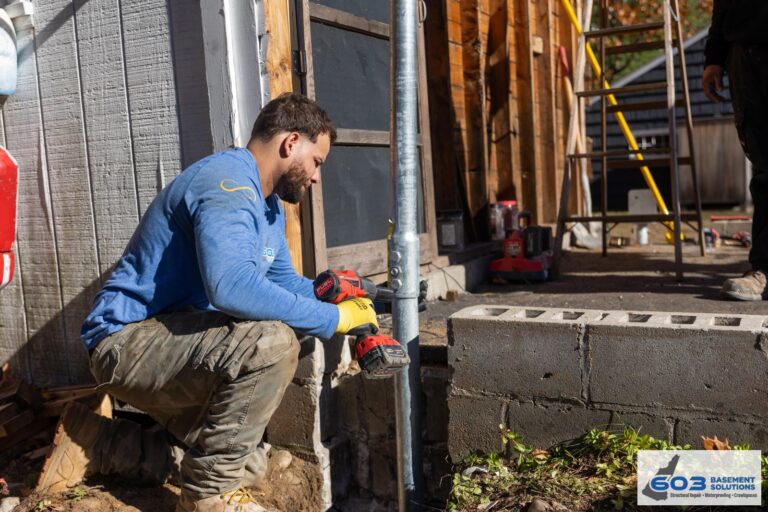
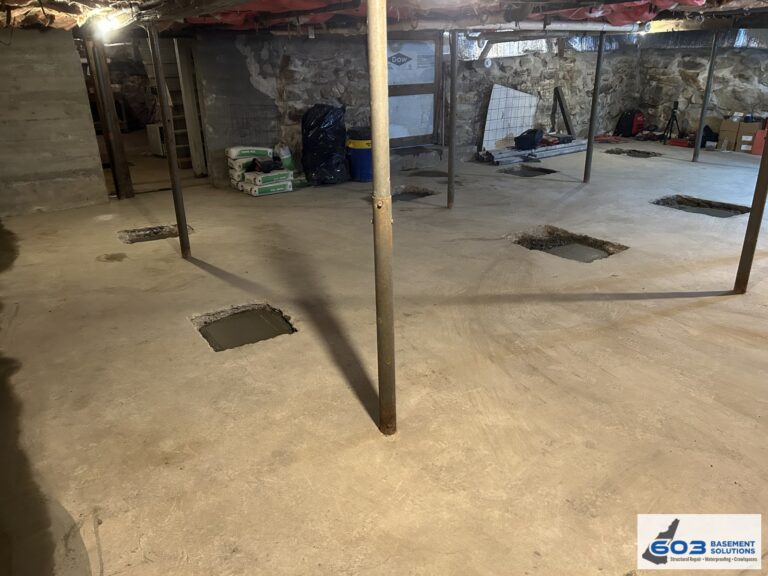
These photographs show real 603 crews and repair details. They explain the method without presenting the work as a verified Peabody project.
Foundation Repair Decisions for a Peabody Home
Treat the timeline as data
When a symptom first appeared, what else was happening at the house, and whether it has changed since are three questions with real diagnostic weight.
Write them down before the visit. Memory compresses, and the sequence is usually more informative than any single observation.
Write an opening schedule
Every wall, ceiling or floor that may need opening should have a location, a purpose, an approval rule and a restoration owner.
Photograph each one before work starts. That record is what makes the restoration conversation short.
Helical Pier and Underpinning Methods for Peabody Homes
Reading the ground through the machine
Torque rises as the helix passes from loose material into something that will carry load. The operator watches that curve rather than a depth mark.
It is the closest thing to a live soil test this work produces. The reading is generated at every pier rather than once per site.
Where driven piers stop making sense
Light framing, small footprints and structures with limited dead load all reduce the reaction available.
Where that limit binds, the honest answer is a different method rather than a longer attempt.
Helical Pier Cost in Peabody, MA
Piers one, two, and three currently cost $2,700 each through 603. Each additional pier costs $2,200. The schedule supplies unit pricing, while the inspection establishes whether piering fits and where. A comparable quote must also identify access, bracket preparation, restoration, and whether lifting is included.
See the helical pier cost guide for worked examples.
Foundation Stabilization vs Structural Lifting
Stabilization is intended to stop further movement at the treated section. An attempted lift asks the system to recover some lost elevation. No responsible proposal guarantees a perfect return to original elevation. Structure and finishes determine the safe limit.
Why Homeowners Choose 603 for Helical Pier Installation
- The proposal identifies the affected section and the intended structural outcome.
- Helical work carries a 25-year engineered performance warranty under the written terms.
- The written scope gives homeowners a concrete plan to compare.
- The scope separates stabilization from an attempted lift before work begins.
Helical Piers vs Push Piers
Helical installation advances the steel shaft by rotation, independent of the structure’s reaction load. With push piers, the building supplies the opposing force. Lightweight construction can limit that approach. The choice follows the load, access, footing, and installation plan. Read the helical pier versus push pier comparison for the full decision.
What a Peabody Helical Pier Proposal Should Contain
It should carry a footing contingency, measured and priced before it is needed.
It should say whether any follow-up reading is included and when it would happen.
Questions to Ask Before Helical Pier Work in Peabody
- Photograph the route. Gates, paving, steps, floors and anything stored along the way.
- Diary a one-year check. A single repeat reading a year on is cheap and settles most later doubts.
- Mark reference points. Tape and a date beside each one, so a later reading repeats this one.
- Ask what is excluded. In writing, itemised, before signing rather than after.
Helical Pier Decisions to Keep Separate in Peabody
Is the quote for the section, or the perimeter?
A perimeter price on a one-corner problem is how this work gets oversold.
Is the scope one size, or stageable?
Most structural work has a core and a margin. Ask where the line falls.
Helical Pier Questions from Peabody Homeowners
What if two inspections disagree?
Ask both contractors to show their measurements and their load-path drawing.
Do I need to be home for the inspection?
Someone should be, so we can ask what changed and when. The history is half the diagnosis.
What if the crew finds something unexpected?
Concealed conditions are normal. The process for measuring and approving them belongs in the document.
What happens to the soil that comes out?
Removal or reuse should be a named line. It is a real cost either way.
How soon can the basement be finished afterwards?
Ask before scheduling finishes. Some work needs a period before surfaces close over it.
What You Receive After a Peabody Inspection
Permit responsibility, working hours, access route and daily reset conditions all appear in writing.
Protection of finished rooms, stored belongings and exterior surfaces is named before mobilisation.
Get a written Peabody finding
We will tell you if the honest answer is to wait and measure again.
Sources: U.S. Census Bureau, 2023 ACS 5-year table B25035. 603 provided the pricing, warranty and operating information quoted here. Imagery is from 603 installations. Read Helical and Push Piers next if the method is the question, or the Structural and Foundation Repair hub if the diagnosis is. Where the wall is stable and only the opening leaks, use Foundation Crack Repair in Peabody. See Service Areas for coverage.